
Choosing the wrong fermenter can lead to poor temperature control, contamination, uneven fermentation, wasted energy, and limited production capacity. These problems become more serious as production grows. The solution is to match the fermenter design with the microorganism, product, fermentation process, batch size, and future production plan.
The main types of fermenters include stirred-tank fermenters, airlift fermenters, bubble column fermenters, packed-bed reactors, membrane bioreactors, solid-state fermenters, batch fermenters, fed-batch systems, and continuous fermenters. For breweries and beverage plants, stainless steel fermentation tanks and cylindroconical fermenters are among the most common choices because they provide sanitary construction, temperature control, yeast management, and scalable production.
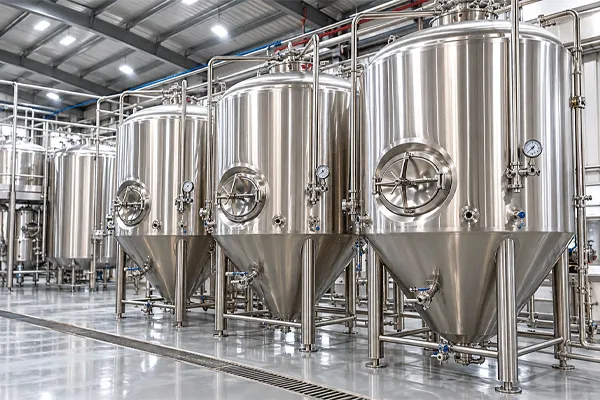
A fermenter may look like a simple tank from the outside. In practice, however, its design affects almost every part of the fermentation process: temperature, mixing, pressure, oxygen, sanitation, microorganism activity, cleaning, production time, and final product quality.
For this reason, understanding the different types of fermenters is useful not only for scientists. It also matters to brewery owners, beverage startups, engineering contractors, production managers, and investors planning a commercial fermentation facility.
What Is a Fermenter and How Does the Fermentation Process Work?
A fermenter is a vessel designed to provide controlled conditions in which a microorganism such as yeast, bacteria, or fungus converts a substrate into a desired product.
Depending on the application, that product may be alcohol, organic acid, biomass, an enzyme, a metabolite, or a fermented beverage.
During fermentation, the microorganism uses nutrients in the fermentation media and carries out a biological or metabolic process. Operators control important conditions such as:
- Temperature
- pH
- Pressure
- Dissolved oxygen
- Agitation
- Nutrient concentration
- Fermentation time
- Carbon dioxide removal
- Sanitation
A commercial fermentation vessel therefore does much more than hold liquid.
For example, during beer fermentation, yeast converts fermentable sugars mainly into ethanol, carbon dioxide, and flavor-active compounds. Temperature must stay within the desired range because even relatively small temperature changes can affect yeast behavior and the finished beer.
In other industrial fermentation applications, oxygen transfer, agitation speed, pH, substrate concentration, or sterile operation may be even more important.
The terms fermenter and bioreactor are often used together. A bioreactor is the broader term. It refers to a controlled vessel in which biological reactions occur. A fermenter is usually a type of bioreactor specifically associated with fermentation.
What Are the Main Types of Fermenters?
There is no single fermenter that works best for every application. The best design depends on the product, microorganism, viscosity, oxygen requirement, operating method, production scale, and sanitation standard.
The most common industrial configurations include:
| Fermenter Type | Main Mixing Method | Typical Advantage | Common Applications |
|---|---|---|---|
| Stirred tank | Mechanical impeller | Strong mixing and process control | Industrial fermentation, biotech |
| Airlift fermenter | Gas-driven circulation | Low shear and lower mechanical complexity | Microbial and cell processes |
| Bubble column | Gas bubbles | Simple construction | Aerobic biological processes |
| Packed bed | Flow through fixed packing | High biomass retention | Immobilized cells or enzymes |
| Membrane bioreactor | Membrane separation | Biomass/product separation | Specialized bioprocessing |
| Solid-state fermenter | Limited free water | Suitable for solid substrates | Food, enzymes, fungal processes |
| Batch fermenter | Closed batch cycle | Flexible and easy to manage | Brewing, food and beverage |
| Fed-batch fermenter | Controlled substrate feeding | Better nutrient management | Industrial fermentation |
| Continuous fermenter | Continuous feed/output | High productivity potential | Large stable processes |
| Cylindroconical tank | Natural circulation/process control | Yeast collection and cold conditioning | Commercial breweries |
Industry references commonly identify the stirred tank, bubble column, airlift, fluidized-bed and related reactor configurations among important submerged-culture bioreactor designs.
For a brewery buyer, however, the practical question is usually much simpler:
Do I need a dedicated fermenter, a cylindroconical unitank, or separate fermentation and bright beer tanks?
That decision directly affects brewery capacity, transfers, labor requirements, tank utilization, and future expansion.
How Does a Stirred Tank Fermenter Work?
A stirred tank fermenter uses one or more mechanically driven impellers to circulate the fermentation broth.
A typical stirred tank reactor may include:
- Motor
- Agitator shaft
- Impeller
- Baffle
- Temperature sensor
- pH sensor
- Gas sparger
- Heating or cooling system
- Sampling ports
- Control system
The impeller helps distribute nutrients, microorganisms, heat, and gases throughout the reactor. Baffles may reduce swirling and improve mixing efficiency.
One major advantage of the stirred tank is control.
When a process requires high oxygen transfer, even temperature distribution, accurate substrate mixing, and strong process monitoring, the stirred design provides engineers with many adjustment options. Research and industry references describe stirred-tank bioreactors as widely used because they can provide strong mixing, oxygen transfer, and temperature control.
However, more mechanical equipment also means more power use, seals, moving components, and maintenance. High agitation can also create shear forces that may not suit every microorganism.
For beverage production, mechanically agitated tanks may be useful for products that require mixing, ingredient blending, or gentle agitation. Traditional beer fermentation itself usually does not require the high-speed impeller arrangement associated with many industrial biotechnology reactors.
What Is an Airlift Fermenter
An airlift fermenter circulates liquid mainly through gas injection instead of a mechanical agitator.
Inside an airlift system, gas enters one section of the vessel. The difference in density between aerated and non-aerated liquid creates circulation.
An internal-loop system normally uses a draft tube, while an external-loop design separates the main circulation paths.
The two circulation zones are commonly called:
- Riser — the gas-rich upward-flow section
- Downcomer — the lower-gas downward-flow section
Because there is no conventional mechanical impeller, airlift bioreactors can offer lower shear and lower mechanical complexity than many stirred reactors.
These characteristics can make an airlift fermenter suitable for certain microorganisms, fungi, algae, and other shear-sensitive cultures. Published engineering literature also notes the relatively low power consumption and gentle mixing characteristics of airlift designs.
Still, airlift equipment is not automatically the best solution for every fermentation process. Fluid viscosity, gas requirements, cell density, heat removal, circulation velocity, and reactor geometry all matter.
For commercial brewery fermentation, a conventional sanitary cylindroconical fermentation tank is normally a more familiar and practical solution than an industrial airlift bioreactor.
What Is a Bubble Column Fermenter?
A bubble column is one of the simpler forms of pneumatic bioreactor.
Gas enters through a sparger near the bottom of the vessel. The rising bubbles provide both aeration and liquid movement.
Compared with a stirred reactor, a bubble column normally has fewer mechanical components. This can reduce mechanical complexity and shear.
Research describes bubble column systems as relatively simple reactors that use gas sparging for mixing and mass transfer.
However, simple does not mean suitable for everything.
When the fermentation broth becomes highly viscous or contains large quantities of solids, mixing can become less uniform. Scale-up also changes gas distribution and fluid movement.
Airlift vs. Bubble Column
| Feature | Airlift | Bubble Column |
|---|---|---|
| Mechanical agitator | Usually no | No |
| Gas-driven mixing | Yes | Yes |
| Defined circulation loop | Yes | Usually no |
| Draft tube | Often used | No |
| Shear | Relatively low | Relatively low |
| Mechanical complexity | Low | Very low |
Both belong to an important group of pneumatic types of bioreactors, but they should be selected through engineering analysis rather than simply by vessel price.
What Are Packed-Bed and Membrane Bioreactors?
A packed bed bioreactor holds cells, microorganisms, or enzymes on or inside a fixed support material. Liquid containing nutrients or substrate flows through the bed.
This approach can maintain a large amount of active biological material inside a relatively compact reactor.
Packed-bed systems can be useful when the process involves immobilized cells or an immobilized enzyme. Their performance depends on flow distribution, pressure drop, mass transfer, packing material, and the tendency of the system to clog.
A membrane bioreactor uses membrane technology as part of the biological process. Depending on the design, the membrane may retain cells, separate products, remove liquid, or maintain a high concentration of biological material.
These reactors are quite different from the sanitary stainless steel tanks normally purchased by a craft brewery.
That distinction matters.
A buyer searching “different types of fermenters” may see laboratory, pharmaceutical, wastewater, biotechnology, and beverage equipment mixed together. The correct bioreactor design must always match the actual product and process.
What Are Batch, Fed-Batch, and Continuous Fermentation?
Fermenters can also be classified by how material enters and leaves the system, rather than only by vessel construction.
Batch Fermentation
In batch fermentation, operators load the required fermentation media or wort, add the microorganism, allow fermentation to proceed, and empty the vessel after the batch is complete.
This batch process is widely used in brewing because it provides strong batch separation, recipe flexibility, and clear production scheduling.
A typical brewery sequence might be:
Wort → Fermentation → Conditioning → Transfer → Cleaning → Next Batch
For craft beer, cider, wine, kombucha, and many other beverages, batch operation makes it easier to produce different recipes and maintain batch identity.
Fed-Batch Fermentation
In fed-batch fermentation, operators add nutrients or substrate during the fermentation process.
This allows better control over nutrient concentration and microbial growth. A fed batch fermentation process is common in industrial biotechnology when adding all substrate at the beginning could inhibit growth or cause undesirable metabolic behavior.
Continuous Fermentation
In continuous fermentation, fresh fermentation media enters while fermented material leaves the reactor.
A continuous stirred tank reactor is one possible configuration.
Continuous fermenters can increase equipment utilization, but the process requires stable operating conditions and careful contamination control. For many independent breweries, the operational flexibility of batch fermenters remains more practical.
How Do Different Types of Fermentation Affect Fermenter Selection?
The type of fermentation strongly influences equipment design.
Not every microorganism needs the same environment.
Aerobic Fermentation
Aerobic processes require oxygen.
Therefore, the reactor may need aeration, agitation, higher oxygen transfer, and more advanced process monitoring.
Stirred tanks, bubble columns, and airlift systems can all be used for suitable aerobic applications.
Anaerobic Fermentation
Anaerobic fermentation occurs without oxygen being continuously supplied as a main process requirement.
Beer production is a familiar example of a process involving alcoholic fermentation by yeast after the wort has first received the oxygen needed to support healthy yeast activity.
During alcoholic fermentation, yeast converts sugars and produces ethanol and carbon dioxide.
Lactic Acid and Acid Fermentation
Bacteria can drive lactic acid fermentation in yogurt, fermented vegetables, and many other products.
Acetic acid fermentation uses microorganisms that convert ethanol toward acetic acid under oxygen-dependent conditions.
Because these different types of fermentation have different biological requirements, equipment may need different control features.
Temperature range, tank pressure, agitator style, gas handling, CIP design, cooling area, fittings, and instrumentation should follow the process rather than a generic tank specification.
What Fermentation Tank Is Best for Beer and Beverage Production?
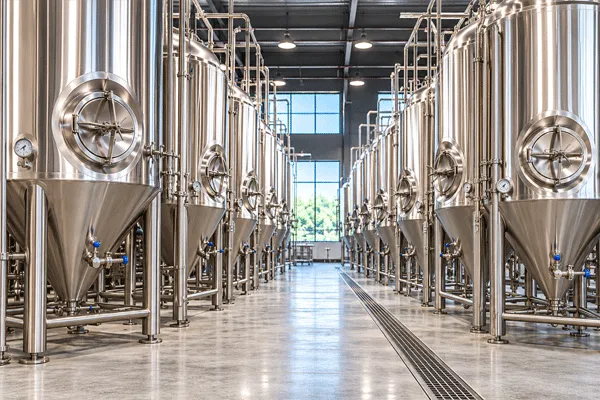
For commercial beer production, the most recognizable design is the vertical stainless steel cylindroconical fermentation tank.
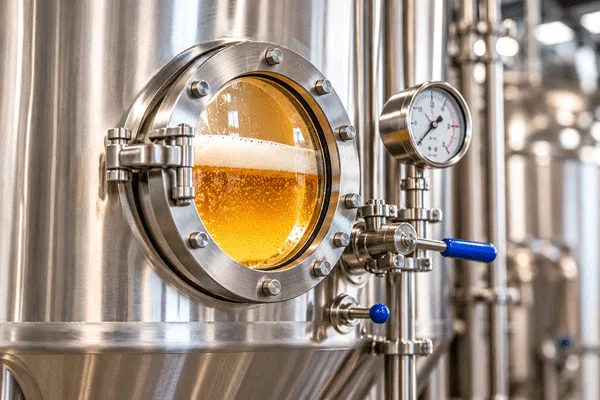
A typical beer fermenter includes:
- Food-grade stainless steel construction
- Cylindrical body
- Conical bottom
- Glycol cooling jacket
- Insulation
- Temperature probe
- Pressure relief device
- Sample valve
- Racking port
- CIP spray device
- Yeast outlet
- Pressure gauge
- Sanitary fittings
The cone helps brewers collect yeast and sediment from the bottom while retaining beer in the tank.
On our current brewery equipment platform, fermentation tanks are offered in configurations ranging from smaller craft brewery systems to large commercial production vessels. Current product configurations include jacketed cylindroconical tanks, unitanks and large-scale fermenters.
Fermenter vs. Unitank vs. Bright Beer Tank
These three vessels should not be treated as identical.
| Tank | Main Function | Typical Use |
|---|---|---|
| Fermenter | Primary fermentation | Wort-to-beer fermentation |
| Unitank | Fermentation + conditioning | Compact craft production |
| Bright beer tank | Carbonation, maturation, storage | Packaging or serving preparation |
A unitank can reduce transfers because fermentation and conditioning can occur in the same vessel.
A separate bright tank, however, can improve production flow in breweries where fermenters need to be released quickly for another batch.
This is why we normally look at the complete cellar schedule rather than selling tanks one at a time.
How Do You Choose the Right Fermenter for a Brewery?
To choose the right fermenter, start with production planning rather than tank price.
The first question should be:
How much finished beverage do you need to produce each week or month?
Then consider how long each product occupies the tank.
For example, imagine a brewery uses a 1,000 L brewhouse.
If one beer remains in fermentation and conditioning for around two weeks, one fermentation vessel cannot support frequent brewing. Multiple fermenters are necessary to keep the brewhouse operating.
A simplified planning example:
| Item | Example |
|---|---|
| Brewhouse batch | 1,000 L |
| Brewing frequency | 3 batches/week |
| Tank occupancy | 14 days |
| Approximate simultaneous batches | 6 |
| Practical starting point | About 6+ matched fermentation positions |
This is only a planning example. The actual number depends on beer style, double-batching, conditioning time, packaging schedule, cleaning time, seasonal demand, and spare production capacity.
Check These Factors Before Ordering
- Working volme
Do not confuse nominal vessel size with usable volume. Headspace must be considered.
- Fermenter volume
Decide whether one fermenter receives one brewhouse batch or two.
- Cooling
The cooling jacket must remove fermentation heat and support cold crashing if required.
- Pressure
Pressure-rated tanks provide more flexibility for closed transfer, carbonation, and certain unitank processes.
- Sanitation
Internal surfaces, welds, valves, fittings, seals, CIP coverage, and drainage all affect contamination risk.
- Cellar height
A larger tank may fit your required volume but not your building.
- Future production
It is usually easier to plan expansion before pipes, glycol lines, platforms, and drainage are installed.
Why Does Stainless Steel Fermenter Design Matter?
A commercial fermenter is a long-term production asset.
The vessel may go through hundreds or thousands of fermentation, cleaning, cooling, filling, pressurization, and emptying cycles during its working life.
That is why stainless steel quality alone does not define a good fermenter.
Fabrication details also matter.
We normally pay attention to issues such as:
- Internal polishing
- Weld quality
- Jacket layout
- Insulation
- Sanitary dead zones
- Drainage
- Manway position
- Valve accessibility
- CIP coverage
- Instrument location
- Working and design pressure
- Tank legs and structural support
The control system is another important part of modern fermentation equipment.
A small brewpub may need relatively simple digital temperature control. A larger commercial project may require centralized PLC/HMI monitoring, automatic valves, process recipes, data logging, and coordinated cooling.
Good fermentation technology should reduce operator workload without making the brewery unnecessarily difficult to maintain.
What Does a Real Commercial Fermentation Project Look Like?
One useful way to understand tank planning is to look at a complete brewery rather than a single fermenter.
For example, a recently published brewery configuration combined a 3,000 L four-vessel brewhouse with both 3,000 L and 6,000 L fermentation tanks. This allows the cellar design to support different production scheduling options instead of forcing every fermentation vessel to use the same capacity.
Another documented project used 5,000 L stainless steel beer fermentation tanks with side manways for a commercial brewery application.
This illustrates an important lesson for buyers:
The best fermentation system is not always the system with identical tanks.
Sometimes a brewery benefits from:
- 1× brewhouse batch fermenters
- 2× brewhouse batch fermenters
- Dedicated lager tanks
- Unitanks
- Bright beer tanks
- Pilot fermenters
The right combination depends on sales volume, recipe mix, brewing frequency, fermentation time, packaging method, available floor area, and planned expansion.
As a brewery and beverage equipment manufacturer, we therefore prefer to discuss the complete workflow: raw material handling, brewhouse output, cellar capacity, glycol cooling, CIP, piping, packaging interface, utilities, installation, and future expansion.
That approach reduces project risk much more effectively than comparing tank prices alone.
Fermentation Equipment Selection Chart
A simple selection chart can help narrow the options:
| Process Need | Suitable Starting Point |
|---|---|
| Craft beer | Cylindroconical fermenter / unitank |
| Brewpub with limited space | Compact unitank |
| Commercial brewery | Jacketed pressure fermenters + bright tanks |
| Cider | Stainless steel fermentation vessel |
| Wine | Wine fermentation tank |
| Kombucha | Sanitary beverage fermentation tank |
| Yogurt | Temperature-controlled agitated fermentation tank |
| High-aeration microbial process | Stirred tank / airlift / bubble column |
| Immobilized cell process | Packed-bed reactor |
| Controlled nutrient feeding | Fed-batch fermenter |
| Continuous stable biological process | Continuous fermenter |
This chart is a starting point, not a final engineering specification.
Your fermentation media, microorganism, fermentation conditions, plant layout, production target, hygiene requirements, and downstream equipment must still be considered.
Frequently Asked Questions About Fermenters
What are the main types of fermenters?
The main types include stirred tank, airlift, bubble column, packed-bed, membrane, solid-state, batch, fed-batch and continuous fermenters. They can be classified either by physical reactor design or by operating method. Breweries commonly use stainless steel cylindroconical batch fermenters and unitanks.
What is the difference between a fermenter and a bioreactor?
A bioreactor is a vessel that provides controlled conditions for a biological reaction. A fermenter is generally a bioreactor used for a fermentation process involving microorganisms such as yeast, bacteria, or fungus. In many industrial discussions, the two terms overlap.
Which fermenter is best for beer production?
For most craft and commercial breweries, a jacketed stainless steel cylindroconical fermenter is the practical standard. It supports yeast collection, sediment removal, temperature control, cleaning, cold conditioning, and—in pressure-rated configurations—closed transfer and natural carbonation.
What size fermenter should I choose?
Match the fermenter to brewhouse batch size, brewing frequency, annual output, fermentation duration, product mix, and available cellar space. Some breweries use one brewhouse batch per tank, while others use larger tanks that receive two or more batches.
What is the difference between batch fermentation and continuous fermentation?
In batch fermentation, a defined volume is fermented and removed before the next cycle. In continuous fermentation, fresh media enters while fermented material leaves continuously. Batch operation gives breweries greater flexibility for changing recipes and maintaining individual batch identity.
Can the same fermenter be used for beer, cider and kombucha?
Not always.
All three may use sanitary stainless steel vessels, but the ideal tank configuration can differ. Beer may require pressure capability and yeast harvesting. Cider may require different fittings or process arrangements. Kombucha may need different gas exchange, temperature, mixing, or pressure conditions.
Always specify the actual beverage and production method before designing the tank.
Final Thoughts: Choosing the Right Fermenter for Your Process
The question “what are the main types of fermenters?” has more than one answer.
From a biotechnology perspective, you may compare stirred tank, airlift, bubble column, packed bed, membrane and other types of bioreactors.
From an operating perspective, you may compare batch fermentation, fed-batch fermentation, and continuous fermentation.
From a brewery perspective, however, the decision becomes much more practical.
You need a fermentation system that matches your brewhouse, recipes, production schedule, building, cooling capacity, cleaning process, packaging line, and expansion plan.
As a manufacturer of customized brewery and beverage equipment, we design fermentation systems around those operating conditions rather than simply offering a fixed tank size. A well-planned cellar can improve batch consistency, simplify cleaning, reduce transfers, improve production efficiency, and leave room for future growth.
If you are planning a craft brewery, brewpub, commercial brewery, cider plant, winery, kombucha facility, or other beverage fermentation project, provide your required fermenter volume, batch size, target annual output, beverage type, building dimensions, and expected production schedule. Those details make it possible to develop a much more accurate tank configuration and brewery layout.
Key Things to Remember
- Fermenters are designed around the biological process, not just tank capacity.
- The main industrial types include stirred tank, airlift, bubble column, packed-bed, membrane, solid-state, batch, fed-batch and continuous systems.
- Stirred tanks provide strong mixing and process control but require more mechanical equipment.
- Airlift and bubble column fermenters use gas-driven circulation and can provide lower-shear operation.
- Batch fermenters are especially common in beer and beverage production.
- Commercial breweries usually rely on sanitary stainless steel cylindroconical fermenters or unitanks.
- Fermenter capacity should be calculated together with brewhouse output and fermentation time.
- Cooling capacity, pressure rating, CIP, sanitary fittings and cellar layout are as important as vessel volume.
- Different beverages require different fermentation conditions and tank configurations.
- Good process optimization starts with the complete production schedule—not with buying the cheapest tank.
- For a new project, calculate brewhouse capacity, fermentation time, brewing frequency, packaging capacity and future expansion together before finalizing the fermentation system.