
Nancy Shang | Founder & CEO, MICET | Published September 17, 2026
Commercial kombucha production needs three equipment categories: fermentation vessels sized for your batch, material suited to kombucha’s acidity, and filling equipment that controls oxygen pickup. What changes as you scale isn’t the chemistry — it’s vessel material, CIP design, and how much of the process stays manual.
Specifications and certification details below reflect information current as of September 2026. Confirm lead times and quote-based pricing directly with your supplier, since those move faster than the underlying equipment mechanics.
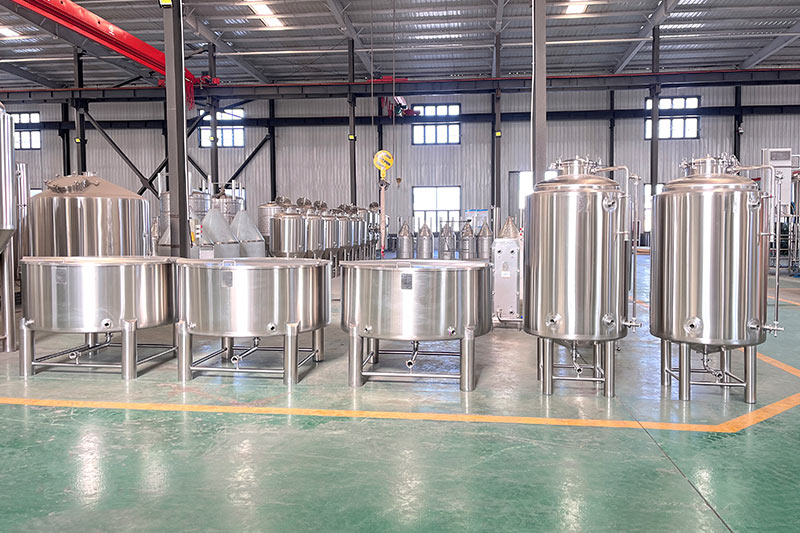
What Commercial Kombucha Equipment Actually Covers
Kombucha production splits into three stages that each need different equipment: primary fermentation (sweet tea plus SCOBY, typically 7–14 days), secondary fermentation (flavoring and carbonation, often under pressure), and packaging (bottling or canning with oxygen control). A pilot operation frequently runs all three stages in one vessel with manual transfers between them. A commercial operation usually separates them into dedicated tanks, because doing otherwise turns tank turnover into your production bottleneck once order volume grows past what one vessel can cycle through.
This is the part first-time producers underestimate: the equipment list doesn’t grow by adding more of the same tank. It grows by adding tank types you didn’t need at pilot scale.
From Pilot to Commercial: What Actually Changes
At pilot scale — roughly 50L to a few hundred liters — a single food-grade fermenter with a CIP-accessible design covers primary and often secondary fermentation both. Batch-to-batch consistency depends more on process discipline than equipment sophistication at this size.
Past a few hundred liters, three things typically change. First, primary and secondary fermentation split into separate vessels, since pressurizing a tank still holding SCOBY complicates cleaning and culture management. Second, temperature control stops being optional — ambient temperature swings that a pilot batch tolerates start producing visible batch-to-batch flavor variation at commercial volume. Third, packaging shifts from manual bottling to a filling machine, because oxygen exposure during manual fills becomes a shelf-life problem once you’re producing for retail distribution rather than a taproom.
None of this means small producers need commercial-grade equipment from day one. It means the jump from pilot to commercial isn’t a straight-line volume increase — it’s a change in how many separate pieces of equipment the process requires.
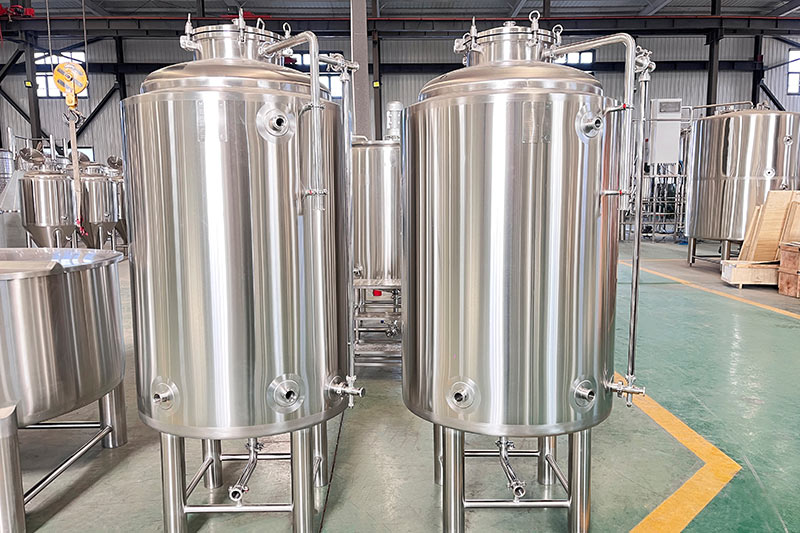
Pilot vs. Commercial Equipment Needs
| Factor | Pilot Scale (50L–500L) | Commercial Scale (1000L+) |
| Fermentation vessels | Often one vessel for primary + secondary | Separate primary and secondary tanks |
| Temperature control | Ambient or basic control acceptable | Glycol jacket typically required |
| SCOBY handling | Manual, low volume | Needs dedicated transfer/harvest workflow |
| Packaging | Manual bottling common | Filling machine with oxygen control |
| CIP | Manual cleaning often sufficient | Integrated CIP nozzle standard |
| Material | Food-grade stainless acceptable across the board | Stainless steel non-negotiable due to acid exposure at volume |
Material Matters More in Kombucha Than in Beer
Kombucha’s acidity — typically in the pH 2.5–3.5 range once fermentation is underway — reacts with metals that beer or wine production tolerates without issue. Copper, common in distillation equipment, has no place in kombucha fermentation vessels; the acidity accelerates corrosion and can introduce copper into the finished product at levels that matter for a beverage marketed on clean ingredients. Food-grade 304 or 316 stainless steel is the standard for kombucha contact surfaces, and 316 specifically is worth the incremental cost for producers running high-acid flavor variations or extended secondary fermentation times, since it resists corrosion better than 304 under sustained acid exposure.
This is a common point of confusion for producers moving equipment over from a different beverage category — a tank rated fine for beer or wine doesn’t automatically clear the bar for kombucha’s acidity profile.
Setting Up a Sanitary CIP Workflow
- Drain the vessel completely before rinsing — kombucha’s SCOBY residue and biofilm buildup concentrate at the bottom and along seams, and skipping full drainage leaves contamination sources behind.
- Rinse with cold water first to clear loose residue before introducing any cleaning solution.
- Circulate an alkaline cleaning solution through the CIP nozzle for the contact time your supplier specifies for your tank size.
- Follow with an acid rinse — kombucha production benefits more from a scheduled acid rinse than beer does, since mineral scale from repeated acidic batches builds up faster.
- Rinse until runoff tests clean, then air-dry or use a sanitizing rinse before the next fermentation cycle begins.
- Inspect SCOBY transfer points and valves by hand periodically, even with automated CIP — biofilm in dead-leg piping is a common source of off-batches that automated cycles don’t always fully clear.
Equipment Specifications
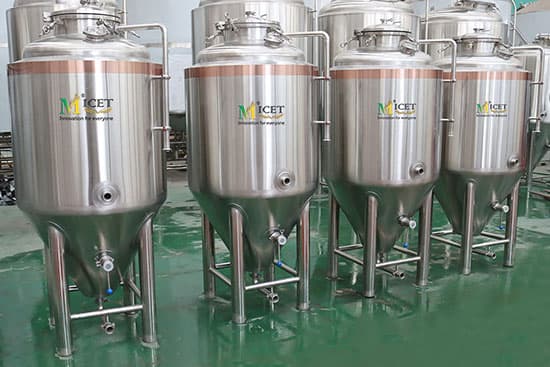
MICET’s brewing equipment line supports batch sizes from small pilot volumes up to 100 barrels capacity, with kombucha brewing equipment as one of four beverage subcategories alongside beer, cider, and wine brewing lines. For the fermentation stage specifically, the fermentation tank line applicable to kombucha runs 500L, 600L, 700L, 800L, 1000L, and 2000L through 2500L at mid-scale, with SUS304 as the standard material (304/316 available on select configurations), a glycol jacket for temperature control, a pressure-reducing valve for pressurized secondary fermentation, and an integrated CIP cleaning nozzle.
| Spec | Detail |
| Brewing equipment capacity range | Small batch through 100 barrels |
| Kombucha subcategory | Included alongside beer, cider, and wine brewing lines |
| Fermentation tank sizes | 500L–2500L (mid-scale), 40BBL–60BBL (large-scale) |
| Material | SUS304 standard; 304/316 on select configurations |
| Temperature control | Glycol jacket |
| Secondary fermentation | Pressure-reducing valve supports carbonated secondary stage |
| Cleaning | Integrated CIP nozzle |
| Published pricing | Not disclosed publicly — requires direct quote |
Packaging: Where Oxygen Control Matters Most
Kombucha’s shelf life is more sensitive to dissolved oxygen than most beer styles, since the live culture and ongoing low-level fermentation in the bottle continue reacting with whatever oxygen gets introduced during filling. Filling equipment rated for beer, cider, and kombucha typically uses vacuum filling, with a twice-vacuum option available specifically to reduce oxygen content further — worth requesting for kombucha lines even if it wasn’t necessary for a beer product on the same equipment.
Certification
Fermentation equipment in this category, including tanks used for kombucha production, is covered under verification of conformity ICR/VC/HM2507146, issued by ICR Co., Ltd. under PED 2014/68/EU, referencing EN 1626:2008 and EN 10204:2004 standards, valid through July 2030. This is a voluntary verification document rather than a mandatory certification, and producers importing into markets with PED requirements should confirm the specific document type their target market requires before assuming any single certificate covers every jurisdiction.
Pricing
Kombucha-specific equipment pricing is not published — batch composition (fermentation-only versus fermentation plus packaging), tank count, and material grade (304 versus 316) all shift the quote enough that a banded price wouldn’t be accurate. For comparison, MICET’s microbrewery brewhouse line does carry a published band of 30,000–80,000 USD, and the commercial brewery line starts at 50,000–80,000 USD for a 10bbl minimum system — kombucha production, by contrast, tends to be quoted per configuration because the fermentation-to-packaging equipment mix varies more between producers than it does in standard beer brewhouse setups.
Trade-offs Worth Weighing
Separating primary and secondary fermentation into dedicated tanks increases upfront equipment cost and floor space, and it buys cleaner SCOBY management along with the ability to run pressurized carbonation without cross-contaminating the culture vessel — a real advantage once production volume makes tank turnover speed matter. Staying with a single combined vessel keeps cost and footprint down, but caps how many batches you can cycle per month and complicates pressurized secondary fermentation in the same tank the SCOBY lives in. Neither approach is wrong at every scale; it’s a question of whether your bottleneck is capital or throughput.
FAQ
Q: Can I use beer fermentation equipment for kombucha without modification?
A: Only if the contact surfaces are stainless steel rather than copper or another acid-reactive metal — kombucha’s acidity is higher than beer’s and will corrode materials beer production tolerates fine.
Q: Do I need separate tanks for primary and secondary kombucha fermentation?
A: Not at pilot scale, where one vessel commonly handles both. Past a few hundred liters, separating them typically improves both SCOBY management and pressurized secondary fermentation control.
Q: What material should kombucha fermentation tanks be made from?
A: Food-grade 304 stainless steel is standard; 316 is worth the added cost for high-acid flavor runs or extended secondary fermentation times.
Q: Why does kombucha need vacuum filling more than some other beverages?
A: Kombucha’s live culture continues reacting with residual oxygen after bottling, so oxygen pickup during filling affects shelf life more directly than it does for many beer styles.
Q: Is pricing for kombucha production equipment published anywhere?
A: Not consistently, and not for MICET’s kombucha-specific configurations — batch composition and material grade vary enough between producers that a banded price wouldn’t be accurate.
Q: What certification should I ask about for kombucha fermentation equipment?
A: Ask specifically about Pressure Equipment Directive (2014/68/EU) verification for fermentation equipment if you’re importing into a market that requires it — this is a separate document from a general CE mark.
The equipment decision most pilot-scale producers postpone too long is whether to separate primary and secondary fermentation — waiting until tank turnover is already your bottleneck makes that transition more disruptive than planning for it while volume is still small.