
Choosing between steam and electric heating is one of the most important decisions when specifying a commercial brewhouse system. The heating method affects installation cost, production speed, energy demand, maintenance, automation, ventilation, and the brewery’s ability to expand.
Neither option is universally better. Steam can provide strong and flexible heating for larger or multi-vessel systems, while electric heating can simplify installation for small and medium breweries that have sufficient electrical capacity. The right choice depends on batch size, brew frequency, available utilities, local energy conditions, building layout, and future production targets.
This guide explains how to compare the two commercial brewhouse heating methods using practical engineering criteria rather than equipment price alone.
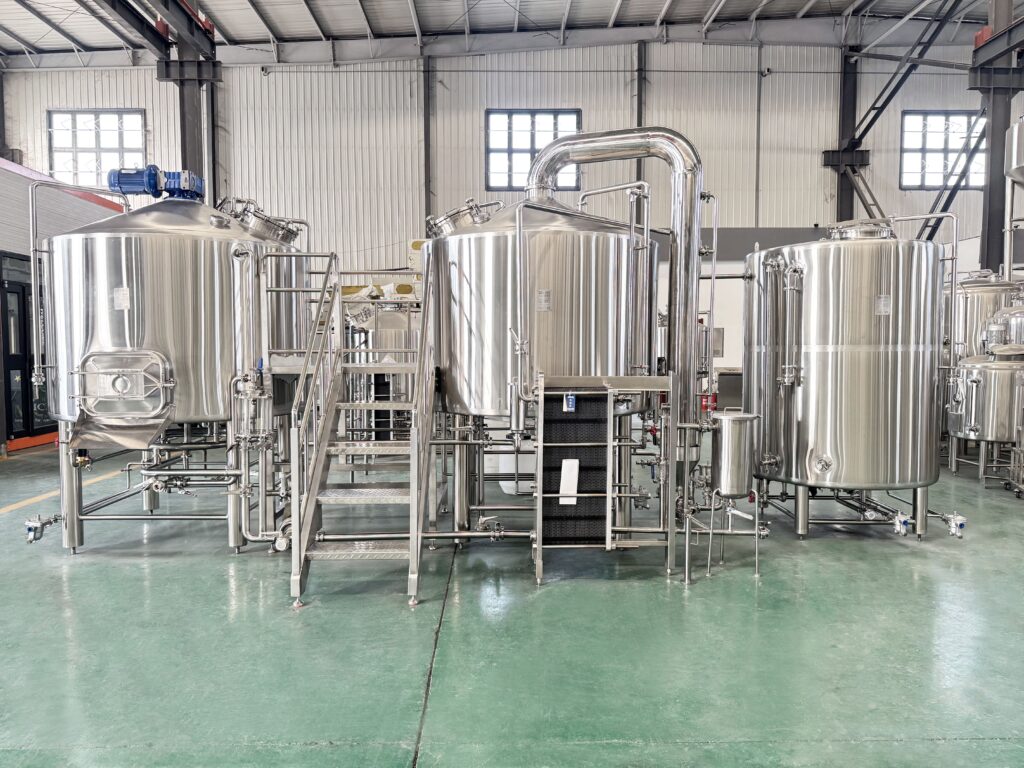
Steam vs. Electric Heating for Commercial Brewhouses: The Short Answer
Choose steam heating when the brewery needs high thermal output, frequent brewing, several heated vessels, or a heating system that can serve other processes. Choose electric heating when the project needs a simpler installation, has reliable electrical capacity, and operates at a scale where a dedicated boiler room would add unnecessary complexity.
A hybrid arrangement can also be considered. For example, a brewery may use electric heating for a smaller brewhouse while reserving steam for larger vessels, hot-water generation, or future expansion. The decision should be based on the complete utility plan, not only the brewhouse purchase price.
How the Two Heating Methods Work
Steam heating
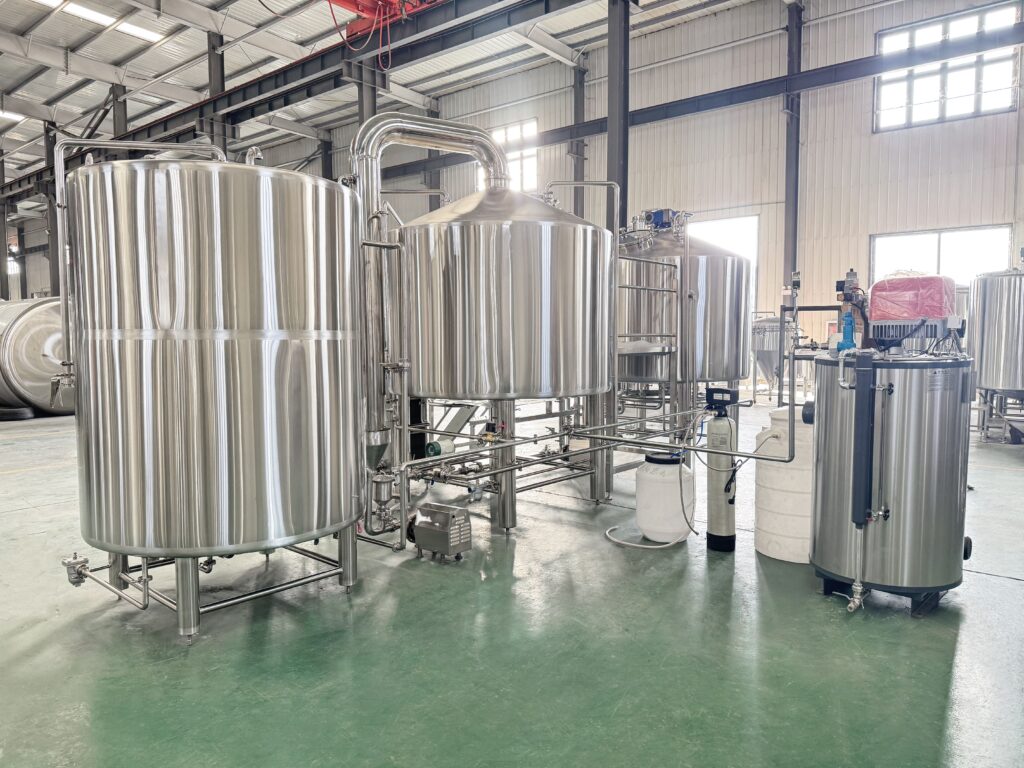
A steam heating system uses a boiler or steam generator to produce steam. The steam passes through jackets or internal heating elements around the mash tun, kettle, or other heated vessel. When steam condenses, it releases heat to the product side of the vessel. Condensate is then removed and may be returned to the boiler system.
Steam is useful when several vessels in a commercial brewery equipment system need heat at the same time or when the brewery requires rapid heat transfer. However, the system also needs a boiler or generator, fuel or electrical supply for the boiler, water treatment, steam piping, pressure controls, condensate handling, ventilation, and safety devices.
Electric heating
An electric brewing system uses immersion elements, external heating elements, or electric heating jackets to transfer heat directly to the vessel. The control system can regulate power in stages and adjust the heating profile according to temperature and time.
Electric heating usually has a simpler process layout because it does not require steam distribution or condensate return. The main requirement is sufficient electrical capacity, correctly sized cables, protection devices, control panels, and ventilation for the electrical equipment.
Electric heating is not automatically low-cost. A brewery must check the available voltage, phase configuration, maximum demand, local electricity tariff, transformer capacity, and whether simultaneous heating loads can be supported.
Steam vs. Electric Heating: Key Differences
| Comparison Point | Steam Heating | Electric Heating |
|---|---|---|
| Main energy source | Boiler-generated steam | Electricity supplied directly to heating elements or jackets |
| Installation complexity | Higher because of boiler, piping, safety devices, and condensate handling | Usually simpler, but requires high electrical capacity and protection |
| Heating response | Strong heat transfer and suitable for high thermal loads | Precise control, with performance depending on installed electrical power |
| Best fit | Medium to large breweries, multi-vessel systems, frequent brewing | Small to medium breweries with reliable electrical infrastructure |
| Simultaneous heating | Well suited when several vessels require heat | Possible, but total electrical demand can become very high |
| Maintenance | Boiler, water treatment, steam traps, valves, and piping | Heating elements, contactors, sensors, cables, and control panels |
| Space requirement | Requires boiler-room or generator space and service access | Requires electrical cabinets and cable routes, but usually less process-room equipment |
| Automation | Supports automated steam valves and temperature control | Supports staged power control and precise temperature adjustment |
| Expansion | Central steam capacity can serve additional vessels | Expansion may require larger cables, breakers, transformers, or a new service connection |
| Main planning risk | Boiler capacity, fuel, water treatment, and pressure safety | Electrical service capacity, peak demand, and heat-up time |
This comparison is a starting point. A well-designed electric brewing system can perform efficiently at the right scale, while an undersized steam system can create delays and unstable production.
A Practical Heating Calculation
Heating demand can be estimated with the basic thermal-energy formula:
Q = m × c × ΔT
Where:
- Q is the required thermal energy;
- m is the mass of the liquid or mash;
- c is the specific heat capacity;
- ΔT is the required temperature increase.
Consider an illustrative 1,000 L water-like brewing load heated from 20°C to 78°C:
- Mass: approximately 1,000 kg;
- Specific heat: approximately 4.18 kJ/kg·°C;
- Temperature increase: 58°C;
- Thermal energy: 1,000 × 4.18 × 58 = 242,440 kJ;
- Equivalent thermal energy: approximately 67.3 kWh.
This is the theoretical energy absorbed by the load. Real systems require more input because of vessel losses, piping losses, heat-transfer limitations, evaporation, insulation quality, and control strategy.
If the effective heating efficiency is assumed to be 85%, the input requirement becomes approximately:
67.3 kWh ÷ 0.85 = 79.2 kWh of input energy
If the brewery wants to complete this heating step in 40 minutes, the average heating capacity would need to be approximately:
79.2 kWh ÷ 0.67 h = 118 kW
This is an illustrative planning calculation, not a final equipment rating. The supplier must confirm the required heating power after considering the actual wort volume, mash thickness, vessel geometry, insulation, target heat-up time, local voltage, steam pressure, and simultaneous loads.
For steam, the same heat demand must be converted into steam flow using the usable heat released by condensing steam and the actual heat-transfer efficiency. The boiler should not be sized only from the nominal brewhouse volume. It should be sized from the peak simultaneous demand of the kettle, hot liquor tank, piping losses, and any other steam users.
When Steam Heating Is Usually the Better Choice
Steam heating becomes more attractive when the brewery has a high or variable thermal load. It can supply several heated vessels from a central system, which is useful when the brewhouse includes a mash tun, kettle, hot liquor tank, and additional process equipment.
Steam may be appropriate when:
- The brewery operates several brews per day or many days per week;
- Several vessels need heat during overlapping process stages;
- The project requires fast heat-up and strong boil control;
- Steam will also serve hot-water generation, cleaning, or other process loads;
- Future expansion is expected to add vessels or increase batch volume;
- The facility already has suitable fuel, boiler space, ventilation, and trained maintenance support.
The main disadvantage is the additional utility system. Boiler sizing, fuel storage, water treatment, pressure relief, inspection, steam traps, condensate return, and operator training all need to be included in the project scope.
When Electric Heating Is Usually the Better Choice
Electric heating can be attractive for breweries that want a compact installation and a simpler process layout. It avoids a separate steam distribution network and may reduce the number of utility systems that must be commissioned before production begins.
Electric heating may be appropriate when:
- The brewhouse is small or medium-sized;
- Brewing takes place one batch at a time with limited overlap;
- The site has sufficient three-phase electrical capacity;
- Local electricity supply is more practical than fuel or boiler installation;
- The brewery wants straightforward temperature and power control;
- Limited floor space makes a boiler room difficult to accommodate.
The main limitation is peak electrical demand. A 120 kW heating load is not the same as a 120 kW average monthly consumption; it can create a significant demand on the site’s transformer, switchgear, cables, and utility connection. The brewery should also check whether other equipment, such as chillers, compressors, pumps, packaging lines, and CIP systems, will operate at the same time.
Energy Cost and Utility Planning
Comparing steam and electric heating only by the price per unit of energy can produce an incomplete result. The calculation should include both energy consumption and the cost of the complete utility system.
A useful comparison should consider:
- Energy price per kWh or per unit of fuel;
- Estimated heating hours per batch and batches per week;
- Boiler or electrical heating efficiency;
- Heat loss from piping, jackets, and uninsulated surfaces;
- Boiler purchase, installation, inspection, and maintenance costs;
- Electrical upgrade, transformer, switchgear, and cable costs;
- Water treatment, fuel storage, ventilation, and condensate handling;
- Labor requirements and planned maintenance downtime;
- Expected production growth over the next three to five years.
For example, electric heating may have a lower initial installation complexity but a higher peak-demand charge. Steam may require more equipment at the beginning but become more economical when the same boiler serves multiple vessels and cleaning operations. The correct comparison is the total cost of ownership over the planned operating period.
Heat-Up Time and Production Capacity
Heating power influences production capacity, but it is not the only factor. A brewery can have a large heater and still produce less beer than expected if the mash schedule, lautering time, transfer capacity, cooling, fermentation tank capacity , or packaging line creates a bottleneck.
A practical production model should include:
- Target batch volume and working volume;
- Heat-up time for each vessel;
- Mash rest and lautering time;
- Boil time and evaporation rate;
- Transfer and cleaning time;
- Wort cooling capacity;
- Fermentation tank availability;
- Packaging and dispatch schedule.
The heating method should support the required brewday rhythm. If the brewhouse must complete four batches per day, the equipment specification must show how the heating system supports overlapping operations rather than only stating a nominal power rating.
Control, Safety, and Maintenance
Both heating methods can be automated, but the control philosophy should be clearly specified. A quotation should distinguish between values that are displayed and values that are actively controlled.
For steam heating, confirm:
- Steam pressure range and control method;
- Boiler or steam-generator capacity;
- Pressure relief and safety devices;
- Steam traps and condensate drainage;
- Jacket design and heat-transfer area;
- Boiler water treatment requirements;
- Inspection and maintenance access.
For electric heating, confirm:
- Total installed heating power;
- Voltage, phase, and frequency;
- Heating-element material and access;
- Over-temperature protection;
- Individual element switching or staged control;
- Main breaker, cable, and control-panel requirements;
- Electrical cabinet ventilation and maintenance clearance.
In both systems, insulation and drainability matter. Poor insulation increases energy consumption, while inaccessible valves, sensors, heating elements, or steam components increase maintenance time and production risk.
How to Choose for a Commercial Brewhouse
The decision can be summarized as follows:
| Brewery Situation | More Suitable Starting Point | Main Reason |
|---|---|---|
| Small brewhouse with one batch at a time | Electric heating | Simpler installation and direct power control |
| Medium brewhouse with occasional overlapping loads | Electric or small steam system | Choice depends on site power, fuel, and expansion plans |
| Large brewhouse with several heated vessels | Steam heating | Central steam supply can serve multiple loads |
| Frequent brewing and high daily output | Steam heating | Strong heat transfer and better support for overlapping operations |
| Limited electrical capacity | Steam, if fuel and boiler installation are practical | Avoids a large direct electrical load |
| No boiler room or limited fuel infrastructure | Electric heating | Reduces process utilities and installation complexity |
| Planned expansion to larger vessels | Steam or planned hybrid system | Easier to centralize future thermal demand when correctly sized |
The table provides a direction, not a final specification. The final choice should be checked against local utility conditions, operating schedule, required heat-up time, maintenance capability, and the brewery’s expansion plan.
Questions to Ask Before Selecting a Heating Method
Before comparing commercial brewhouse quotations, ask the supplier to state:
- Is the quoted capacity nominal volume or working volume?
- What heat-up time is assumed for each vessel?
- Is the heating power calculated for water, wort, or mash?
- What efficiency and heat losses are included?
- Can multiple vessels be heated at the same time?
- What utility capacity is required at peak operation?
- What insulation thickness and material are included?
- What safety devices and control functions are supplied?
- How are heating elements, steam valves, and sensors accessed for maintenance?
- Can the heating system support the planned future production volume?
A clear quotation should connect the heating method to a production schedule. A statement such as “electric heating, 120 kW” or “steam heating, 300 kg/h” is not enough unless the assumed batch size, heat-up time, steam pressure, efficiency, and simultaneous loads are also defined.
Conclusion
The choice between steam and electric heating for a commercial brewhouse depends on more than the heater itself. Electric heating can simplify installation and provide direct control for smaller operations with adequate electrical capacity. Steam heating can better support high thermal loads, overlapping vessel operations, and future expansion when the brewery can manage the boiler and utility infrastructure.
The most reliable decision comes from calculating the required heat energy, peak power, operating hours, heat-up time, and total utility cost. These figures should then be checked against the brewery layout, electrical or fuel supply, maintenance resources, safety requirements, and expected production growth. A correctly sized heating system supports the entire brewday without creating a new bottleneck elsewhere in the brewery.