
Choosing the wrong distillation equipment can limit output, waste energy, reduce product consistency, and create safety problems. The challenge becomes greater when a project moves from a small laboratory setup to commercial production. The solution is to match every piece of equipment to the liquid, production capacity, target purity, and distillation method.
A complete distillation setup normally needs a boiler or still, heating system, distillation vessel, column or head, condenser, collection tank, cooling system, temperature and pressure controls, piping, pumps, and safety equipment. For alcoholic beverages, the system may also include fermentation tanks, spirit receivers, CIP equipment, filtration, blending tanks, and storage vessels.
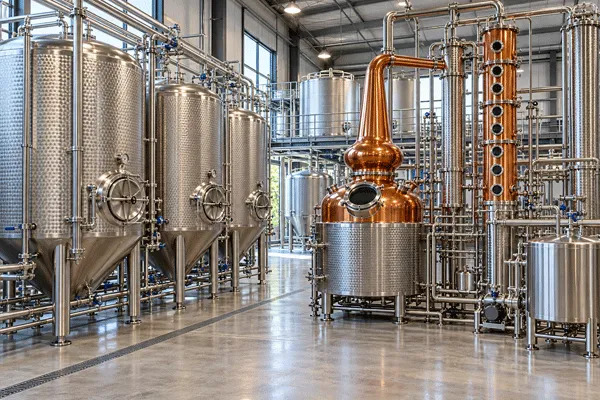
For a small laboratory, the apparatus may consist of only a flask, thermometer, condenser, receiver, and heat source. A commercial distillery is very different. It needs a complete process line designed for stable output, sanitary operation, cooling, control, cleaning, and safe handling of ethanol vapor.
As a manufacturer of stainless steel brewery and beverage processing equipment, we often look at the whole production flow rather than one machine. For distillery projects, fermentation, liquid transfer, storage, cooling, cleaning, utilities, and downstream handling should all work together with the main distillation system.
What Is Distillation and How Does the Distillation Process Work?
Distillation is a process used to separate or purify components of a liquid mixture by taking advantage of differences in volatility and boiling point.
The basic idea is simple.
A liquid mixture is heated. The more volatile compound begins to evaporate more easily. That vapor travels to a condenser, where it is cooled and changed back into liquid. The collected liquid is called the distillate.
The basic flow looks like this:
Feed Liquid → Heating → Vapor Formation → Separation → Condensation → Distillate Collection
For example, a mixture containing water and ethanol can be heated so that the vapor contains a higher proportion of ethanol than the original liquid. By controlling boiling and condensation carefully, the operator can increase alcohol concentration.
The distillation process therefore depends on several factors:
- Composition of the mixture
- Boiling point of each compound
- Vapor pressure
- Heating rate
- Column design
- Condenser capacity
- Reflux
- Cooling water temperature
- Operating pressure
- Desired product purity
Good temperature control matters because distillation is not simply a case of “heat it until it boils.” A stable process gives better separation, safer operation, and more repeatable product quality.
What Distillation Equipment Is Needed for a Commercial Distillery?
The exact equipment is needed depends on the product and the scale of the project, but most commercial systems include several core sections.
| Equipment | Main Function |
|---|---|
| Distillation vessel / still | Heats the fermented liquid |
| Heating system | Supplies steam, electricity, or thermal energy |
| Column / head | Improves component separation |
| Condenser | Turns vapor back into liquid |
| Receiver | Collects distillate |
| Cooling system | Removes heat from vapor |
| Pumps | Transfer liquid between process stages |
| Piping and valves | Control product flow |
| Sensors and controls | Monitor temperature and pressure |
| Fermentation tanks | Produce the alcoholic feed before distillation |
| Storage tanks | Hold feed, distillate, or finished spirit |
| CIP system | Cleans tanks and process piping |
| Safety equipment | Controls pressure, vapor, heat, and fire risk |
These are the main pieces of distillation equipment, but a practical distillery normally needs more than the still itself.
Before the operator can distil alcohol, fermentation must already have converted sugars into ethanol. This means the upstream fermentation system has a major influence on the performance of the distillation line.
For this reason, investors should plan the fermentation tanks, distillation area, cooling capacity, storage vessels, pumps, piping, wastewater handling, and packaging flow as one production system.
What Are the Main Parts of a Distillation Apparatus?
A distillation apparatus may be very small or very large, but its basic principles remain similar.
In a laboratory setting, a typical simple distillation apparatus contains:
- Distillation flask
- Heat source
- Thermometer
- Condenser
- Receiver flask
- Connecting glassware
- Clamps and supports
The distillation flask holds the mixture. Heat causes part of the liquid to form vapor. That vapor travels through the apparatus into the condenser.
Inside the condenser, cooling water removes heat. The vapor begins to condense, producing liquid distillate that flows into the receiver.
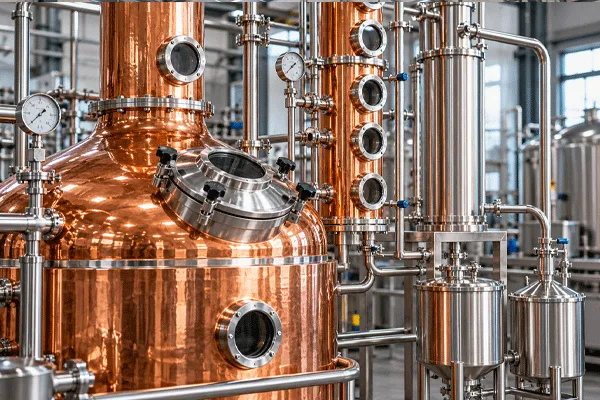
A commercial distillation apparatus replaces small glass components with larger stainless steel or copper process equipment.
Instead of a laboratory flask, there may be a stainless steel or copper pot still. Instead of a small glass condenser, the plant may use an industrial shell-and-tube condenser or other sanitary heat exchanger.
The principle remains:
Heat the liquid, create vapor, separate components, cool the vapor, and collect the desired distillate.
What Is the Difference Between Simple and Fractional Distillation?
Simple distillation is suitable when components have sufficiently different boiling points or when the main goal is removing a volatile solvent from a less volatile material.
The apparatus is relatively simple.
The vapor moves from the boiling vessel directly toward the condenser. There is limited repeated contact between rising vapor and returning liquid.
Fractional distillation adds a fractionating column between the boiling vessel and condenser.
Inside the column, vapor rises while condensed liquid flows downward. This repeated vapor-liquid contact improves separation.
A fractional column may contain:
- Trays
- Structured packing
- Random packing
- Glass beads in a laboratory system
- Stainless steel packing
- Copper packing
A laboratory column may be packed with glass beads or similar material. The purpose of the glass beads or other packing is to increase surface area for repeated evaporation and condensation.
Simple Distillation vs. Fractional Distillation
| Feature | Simple Distillation | Fractional Distillation |
|---|---|---|
| Equipment complexity | Lower | Higher |
| Separation ability | Moderate | Higher |
| Fractionating column | No | Yes |
| Best for | Large boiling-point difference | Closer boiling points |
| Energy/control requirements | Lower | Higher |
| Typical applications | Solvent recovery, basic separation | Spirits, chemicals, refining |
The different boiling points of the compounds still drive the separation, but fractional distillation creates more opportunities for the vapor and liquid phases to reach equilibrium.
This is why the column design matters so much.
What Is a Fractionating Column and Why Is It Important?
A fractionating column improves the purity of the separated product.
As hot vapor rises, it contacts cooler liquid moving down through the column. Some compounds condense while more volatile compounds continue upward.
This creates repeated stages of separation.
The effectiveness of the column depends on:
- Column height
- Diameter
- Packing type
- Number of trays
- Reflux ratio
- Vapor velocity
- Liquid flow
- Pressure in the column
- Heat input
For beverage distillation, the column configuration can strongly influence the final spirit character.
A short column may allow more flavor compounds to carry through. A taller or more efficient column can produce higher-purity alcohol.
This means there is no universal “best” design.
The right equipment depends on whether the distiller wants a highly purified neutral spirit, a character-rich whiskey, brandy, rum, gin base, or another alcoholic beverage.
What Are the Different Types of Distillation?
There are several types of distillation, each suited to different materials and processing goals.
Simple Distillation
This is the most basic method. It is suitable for relatively easy separation.
Fractional Distillation
Fractional distillation uses a column to improve separation between compounds with closer boiling points.
Steam Distillation
Steam distillation passes steam through material or uses steam to help carry volatile compounds.
It is common in the extraction of essential oils from plant material.
Vacuum Distillation
Vacuum distillation reduces the pressure inside the system.
Lower pressure reduces the boiling temperature of the liquid, which can help process heat-sensitive compounds or materials with high boiling points.
Batch Distillation
In batch distillation, a fixed amount of liquid is processed at one time.
This approach is common in craft spirit production because it gives the operator flexibility over recipes and cuts.
Continuous Distillation
Continuous systems feed liquid into the apparatus while product streams leave continuously.
They can improve productivity in large plants but require more complex controls.
Azeotropic Distillation
Azeotropic distillation uses additional process methods to separate mixtures that cannot easily be separated by conventional distillation.
Molecular Distillation
Molecular distillation operates under very low pressure and is used for specialized high-value or heat-sensitive products.
These different types of distillation show why equipment selection should always start with the required process, not only the tank capacity.
When Is Steam Distillation Used?
Steam distillation is useful when the desired compound is volatile but can be damaged by direct high-temperature heating.
The method is widely associated with essential oil processing.
Steam passes through or around plant material. The heat releases volatile aromatic compounds, which move with the water vapour into the condenser.
After condensation, the oil and water phases can often be separated.
Typical applications include oils derived from:
- Lavender
- Peppermint
- Eucalyptus
- Citrus materials
- Rosemary
- Other aromatic plants
The equipment often includes:
- Steam generator
- Extraction vessel
- Condenser
- Oil separator
- Receiver
- Cooling system
This is different from beverage distillation, even though both processes use vaporization and condensation.
If a manufacturer is designing equipment for the extraction of essential oils, the vessel shape, steam distribution, basket system, condenser sizing, and oil-water separator must match the plant material and production target.
Why Is Vacuum Distillation Used for High-Boiling or Heat-Sensitive Liquids?
Every liquid has a relationship between pressure and boiling temperature.
When system pressure drops, the temperature required for boiling can also fall.
That is the basic reason vacuum distillation works.
This technique is useful when:
- A compound has a high normal boiling point
- Heat may damage the product
- The operator wants lower process temperatures
- Conventional distillation would consume too much energy
- Product color, aroma, or chemistry may change under high heat
Vacuum equipment normally requires additional components, such as:
- Vacuum pump
- Vacuum-rated vessel
- Pressure sensor
- Vacuum control valve
- Condenser
- Receiver
- Leak-tight piping
The apparatus must also handle the lower pressure safely.
For beverage alcohol production, vacuum methods are less common than conventional pot or column distillation, but they can still appear in specialized distillation technology.
How Important Is the Condenser in a Distillation Setup?
The condenser is one of the most important components in the whole distillation setup.
It removes heat from vapor and changes it back into liquid.
If the condenser is too small, vapor may not fully condense. That can cause product loss and create serious safety concerns, especially when ethanol is involved.
The condenser design should consider:
- Maximum vapor load
- Cooling water temperature
- Cooling water flow
- Condensing surface area
- Product temperature
- Pressure
- Material compatibility
In a simple laboratory apparatus, a small glass condenser may be enough.
In a commercial distillery, the condenser may be a much larger sanitary heat exchanger.
A properly sized condenser should be able to cool the vapor under peak operating conditions, not only under average production conditions.
This is especially important when scaling up.
A system that performs well at 100 liters may behave very differently at 1,000 or 5,000 liters because vapor generation and cooling demand increase substantially.
Why Are Fermentation Tanks Important Before Distillation?
Distillation cannot create alcohol from nothing.
The alcohol must first be produced through fermentation.
Yeast converts fermentable sugar into ethanol and carbon dioxide. The resulting fermented liquid becomes the feed for distillation.
For example:
Raw Material → Mashing / Sugar Preparation → Fermentation → Distillation → Spirit Collection → Maturation / Storage
For a grain-based distillery, upstream equipment may include:
- Mash vessel
- Hot water tank
- Fermentation tanks
- Pumps
- Heat exchanger
- Cooling system
- CIP system
- Transfer piping
For fruit spirits, the process may require different preparation and fermentation equipment.
This is an area where brewery equipment experience becomes useful.
Sanitary stainless steel fermentation tanks, glycol cooling, process piping, pumps, valves, and CIP systems are already central to brewery and beverage manufacturing. These same principles help create a stable feed stream for a distillery.
A poorly controlled fermentation process reduces alcohol yield before the distillation apparatus even starts working.
How Do You Choose the Right Distillation Equipment for a Commercial Project?
Start with the product.
Do not begin by asking only:
“How many liters is the still?”
Instead, define the complete process.
1. What Product Will You Distil?
Whiskey, vodka, gin, rum, brandy, fruit spirit, essential oils, solvent, and purified water may all require different apparatus.
2. What Is Your Batch Size?
A 500 L batch system and a 5,000 L system have very different heating, cooling, vapor, and storage requirements.
3. What Alcohol Strength Do You Need?
Higher purity may require a more efficient fractional column or additional distillation stages.
4. What Heating Source Is Available?
Common options include:
- Steam
- Electric heating
- Thermal fluid
- Direct heating in some applications
Steam is widely used in industrial equipment because it provides controllable heat.
5. How Much Cooling Capacity Is Available?
Do not underestimate cooling.
The condenser and downstream cooling equipment must remove substantial heat.
6. What Material Should the Equipment Use?
Commercial beverage systems commonly use stainless steel, copper, or a combination of both.
The material selection should consider:
- Product chemistry
- Flavor goals
- Cleaning
- Corrosion
- Sanitary requirements
- Maintenance
7. How Will the System Be Cleaned?
A well-planned commercial system should minimize dead zones and support reliable cleaning.
Depending on the design, CIP may clean:
- Fermentation tanks
- Process piping
- Pumps
- Storage tanks
- Certain parts of the distillation line
Good sanitation reduces impurity, contamination risk, and downtime.
What Safety Equipment Is Needed for Distillation?
Distillation combines heat, vapor, pressure, and potentially flammable liquids.
That makes safety equipment an essential part of commercial system design.
Typical safety considerations include:
- Pressure relief devices
- Vacuum protection
- Temperature sensors
- Pressure gauges
- Emergency shutoff
- Proper ventilation
- Explosion-risk management where required
- Grounding and bonding
- Fire detection and suppression
- Safe ethanol storage
- Controlled vapor handling
Ethanol vapor can ignite, so electrical equipment and room design may need to comply with the applicable local safety codes.
Waste also requires attention.
Distillation waste may include spent wash, process water, cleaning solution, solids, and other residues. The plant should plan drainage and waste handling before installation.
A professional engineering contractor should also confirm local building, electrical, fire, environmental, and alcohol-production requirements.
A Practical Commercial Distillation System Example
Consider a startup planning a craft spirit facility.
The team expects to process fermented liquid in batches rather than run continuously.
A simplified production flow might look like this:
| Process Stage | Equipment |
|---|---|
| Raw material preparation | Milling / processing equipment |
| Mash preparation | Stainless steel mash vessel |
| Fermentation | Jacketed fermentation tanks |
| Transfer | Sanitary pumps and piping |
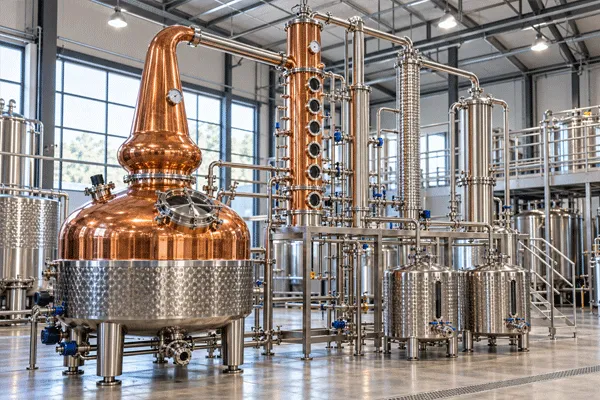
| Distillation | Pot still + column |
| Condensation | Industrial condenser |
| Spirit collection | Stainless steel receivers |
| Blending | Blending tank |
| Storage | Spirit storage tanks |
| Cleaning | CIP equipment |
| Cooling | Chiller / cooling water system |
| Control | Temperature and pressure controls |
At first, the still may appear to be the most important investment.
But in practice, the full line determines productivity.
If fermentation capacity is too small, the distillation unit waits for feed.
If the condenser is undersized, production must slow down.
If the storage tanks are insufficient, finished spirit has nowhere to go.
If cleaning takes too long, effective daily production falls.
That is why we recommend looking at capacity planning across the entire process rather than purchasing isolated machines.
Frequently Asked Questions About Distillation Equipment
What equipment is needed for basic distillation?
A basic distillation apparatus needs a vessel or flask, heat source, vapor path, condenser, receiver, temperature measurement, and cooling system. Commercial systems also need pumps, piping, controls, storage vessels, and safety equipment.
What equipment is needed to distil alcohol?
Commercial alcohol distillation normally requires fermentation tanks, a pot still or column still, heat source, condenser, spirit receiver, cooling system, pumps, sanitary piping, controls, and storage tanks. Larger plants may also use CIP, automated controls, filtration, blending, and packaging equipment.
What is the difference between a pot still and a column still?
A pot still usually processes liquid in batches and provides relatively limited separation in each run. A column still creates repeated vapor-liquid contact and can achieve stronger separation and higher alcohol purity. The correct choice depends on spirit style and production goals.
Why is a condenser necessary in distillation?
The condenser removes heat from vapor so it can return to liquid form. Without enough condensation capacity, product may be lost as vapor and the system may become unsafe.
Can stainless steel be used for distillation equipment?
Yes. Stainless steel is widely used for commercial tanks, piping, receivers, fermentation vessels, and many distillation system components because it is durable, sanitary, corrosion-resistant, and easy to clean. Copper may also be used in specific sections of beverage distillation equipment.
How do I choose the right equipment for a distillery?
Start with the product, desired production volume, alcohol strength, batch frequency, heating method, cooling availability, building layout, automation level, and future expansion. Then size fermentation, distillation, storage, and utility equipment as one system.
Final Thoughts: Plan the Whole Distillation Process, Not Just the Still
The answer to “What equipment is needed for distillation?” depends on scale and purpose.
A laboratory may need only a flask, condenser, heat source, thermometer, and receiver.
A commercial distillery needs much more.
It needs a complete production system that can manage fermentation, heating, vapor separation, condensation, product collection, cooling, cleaning, storage, safety, and future expansion.
For brewery and beverage investors, this point is especially important.
The distillation apparatus is only one stage in the process.
Upstream fermentation capacity determines how much alcoholic feed is available. Cooling determines how fast the condenser can work. Storage capacity determines how smoothly production can continue. Sanitary piping and CIP affect product quality and downtime.
As a manufacturer focused on customized stainless steel brewing and beverage processing systems, we approach these projects from the perspective of complete process integration. Fermentation tanks, process vessels, cooling, pumps, piping, cleaning systems, and production layout should support the distillation line instead of being designed separately.
Before requesting a quotation, prepare the following information:
- Product you plan to distil
- Raw materials
- Batch volume
- Daily or annual production target
- Expected alcohol concentration
- Heating source
- Available cooling water
- Building dimensions
- Automation requirements
- Tank requirements
- Local electrical standard
- Future expansion plan
The more accurate this information is, the easier it becomes to select the right equipment and avoid costly changes later.
Key Things to Remember
- Distillation separates or purifies liquid components through vaporization and condensation.
- A basic distillation apparatus includes a vessel, heat source, vapor path, condenser, and receiver.
- Commercial distillation requires pumps, piping, controls, cooling, storage, and safety systems.
- Fractional distillation uses a column to improve separation.
- Simple distillation suits easier separations with larger boiling-point differences.
- Steam distillation is widely used for aromatic plant materials and essential oils.
- Vacuum distillation helps process heat-sensitive or high-boiling materials.
- The condenser must be sized for the maximum vapor load.
- Commercial spirit production also requires well-planned fermentation capacity.
- Heating, cooling, fermentation, distillation, storage, and CIP should be designed as one production flow.
- Equipment size alone does not determine performance.
- The best distillation system matches the product, production target, building, utilities, and future growth.