
For any brewery founder, the allocation of initial capital is the most critical series of decisions they will make. The equipment market presents a wide spectrum of options, from foundational systems to high-automation technology. An incorrect capital strategy, often driven by marketing narratives rather than operational reality, can create significant financial strain and operational bottlenecks before the first batch is sold.
This document serves as a decision-making framework. Its purpose is to analyze common capital allocation errors observed in the startup and growth phases of a brewery’s life cycle. We will dissect equipment categories that frequently represent a low return on investment (ROI) for new ventures and contrast them with foundational investments that deliver outsized returns in efficiency, quality control, and scalable growth.
Low-ROI Investments: Common Capital Traps for Startups
Certain equipment categories, while valuable for scaled, mature operations, represent a premature allocation of capital for a startup. They often tie up funds that would be more productively invested in revenue-generating capacity.
1. The Over-Engineered Conical Fermenter
A complex conical fermenter with multiple ports, sample valves, and intricate racking arms is often perceived as a mark of professionalism. However, from a process standpoint, this complexity introduces liabilities for a startup. Complex geometries increase sanitation risks and lengthen CIP (Clean-in-Place) cycles. For most standard brewing operations, the additional functionality offers negligible benefit over a well-constructed, simpler stainless steel fermenter. The capital premium for such features is better allocated toward an additional fermentation vessel, which directly increases production capacity.
2. The Fully Automated Brewhouse
A PLC-driven, automated beer brewing system promises labor savings and repeatability. For a startup, this is a capital trap. The initial investment is immense, and the actual labor savings at a small scale are minimal, as a brewer’s presence is required regardless of automation level. Furthermore, a manual system forces the brewing team to develop a deep, tactile understanding of the process, which is invaluable for troubleshooting and recipe development. A manual 3-vessel-brewhouse is often a more appropriate starting point, as it teaches the fundamentals while remaining highly effective. High automation introduces a layer of abstraction and a maintenance dependency that a new business is ill-equipped to handle.
A Note on Balanced Perspective
It is critical to state that for an established, scaled brewery focused on maximizing throughput and labor efficiency, a high-speed canning line or a fully automated brewhouse is often a logical, ROI-positive investment. At that scale, labor savings are significant and consistent production schedules demand such technology. However, for a startup, the capital is unequivocally better allocated to revenue-generating capacity (i.e., more fermenters), as the payback period on high-automation equipment is prohibitively long.
3. An In-House, High-Speed Canning or Bottling Line
The desire for total control over packaging leads many founders to invest in an in-house canning line or beer bottling machine from day one. This is a strategic error. A packaging line is a significant capital expense, a major space commitment, and a new operational department requiring skilled labor.
The more financially sound strategy is to leverage mobile canning or bottling services. This converts a massive capital expenditure (CapEx) into a manageable, per-unit operational expenditure (OpEx).
ROI Analysis: In-House vs. Mobile Canning
| Metric | Mobile Canning Service | In-House Canning Line | Breakeven Analysis |
| Upfront Cost (CapEx) | Zero. | $25,000 – $200,000+ | Preserves crucial startup capital for other needs. |
| Per-Unit Cost (OpEx) | High. (e.g., ~$0.40/can) | Low. (e.g., ~$0.15/can) | The long-term advantage of ownership, but irrelevant if capital is exhausted. |
| Breakeven Point | N/A | A $250,000 line must package over 800,000 cans to recoup its cost vs. a mobile service. | For a startup, this can represent several years of production, making mobile services the clear choice. |
4. An Oversized Brewhouse
The “we’ll grow into it” philosophy often leads to purchasing a brewhouse (e.g., a 20bbl brewing system) with a cellar capacity that cannot support its output. The fundamental principle of brewery growth is “Cellar First.” Revenue is generated by fermenting and selling beer, not by brewing capacity. An underutilized brewhouse is an idle asset. A smaller, correctly-sized brewhouse operated more frequently is a far more capital-efficient model.
5. A Full, Advanced Quality Control Laboratory
While a commitment to quality is non-negotiable, a startup does not require a full suite of advanced analytical tools like gas chromatographs or PCR testing equipment. This is another area where outsourcing is the prudent financial choice. A “Lean Lab” model is the correct approach for a startup, focusing on tools that provide daily, actionable data.

High-ROI Investments: Foundational Equipment for Efficiency & Quality
In contrast, the following investments provide immediate and substantial returns by saving labor, protecting product quality, and enabling scalable growth.
1. A Reliable Dissolved Oxygen (DO) Meter
This is the single most important quality control instrument for a brewery that packages its product. It is not a laboratory luxury; it is a critical tool for shelf-life stability and brand reputation management. A DO meter is the only way to diagnose and eliminate oxygen pickup during transfers and packaging. Preventing a single batch of oxidized beer from reaching the market provides an ROI that far exceeds the instrument’s cost.
2. A Semi-Automated Keg Washer
Manual keg cleaning is a significant drain on labor resources. A dedicated beer keg filling machine that also performs cleaning and sanitizing cycles is a direct investment in operational efficiency. It reallocates hundreds of hours of labor per year from a low-skill, repetitive task to revenue-generating activities like brewing, cellaring, and sales. It also ensures a higher, more consistent standard of sanitation than manual cleaning.
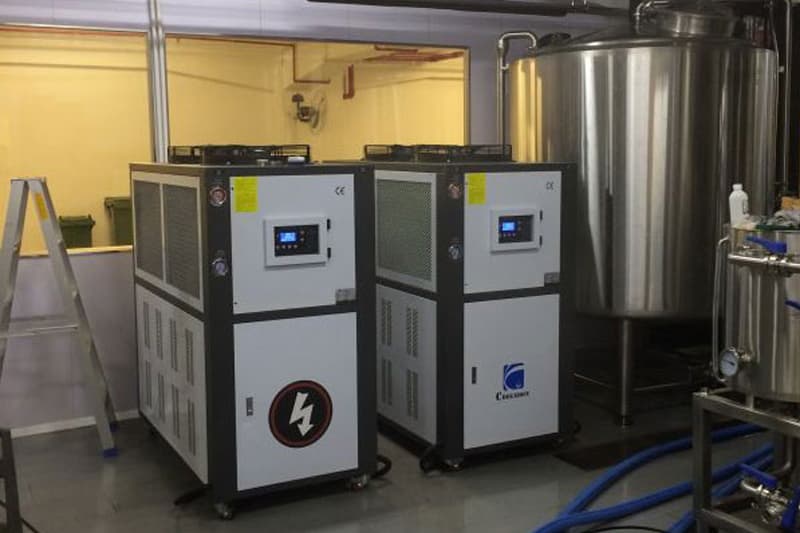
3. An Oversized Glycol Chiller
The glycol refrigeration system is the circulatory system of the cellar. Sizing a chiller precisely to day-one needs is a common mistake that creates a critical production bottleneck in the near future. An undersized chiller cannot effectively “crash” multiple tanks simultaneously, delaying beer turnaround and disrupting the production schedule. Investing in a chiller with 50% more capacity than immediately required is one of the most effective ways to future-proof the brewery for a marginal upfront cost increase.
4. A Portable CIP Cart
Instead of investing in expensive, hard-piped CIP systems, a mobile CIP cart offers superior flexibility at a fraction of the cost. A self-contained unit with its own pump, heating element, and reservoirs can service any tank in the brewery. It standardizes cleaning procedures, improves safety, and ensures consistent sanitation results, making it a foundational piece of equipment for any professional micro brewery setup.
5. A Used Forklift
Often overlooked in equipment budgets, a forklift or walk-behind stacker is a force multiplier for a small team. It is a fundamental tool for workplace safety and operational efficiency, enabling the safe movement of grain pallets, stacked kegs, and brite tanks. The reduction in injury risk and the dramatic increase in material handling speed deliver a clear and immediate return.
Asset Flexibility: Applications Beyond Beer Production
A key consideration for founders is the versatility of their capital assets. The core equipment of a brewery—specifically stainless steel tanks—is highly adaptable for producing other fermented beverages, opening potential new revenue streams with minimal additional investment.
- Cider & Wine: A cider fermenter or wine fermenter shares the same fundamental design as a beer fermentation tank. Suppliers often provide equipment, such as a stainless steel wine fermentation tank, that is suitable for multiple beverage types.
- Kombucha & Other Beverages: The growing market for kombucha can be entered using a dedicated kombucha brewing vessel, which is often a simple modification of a standard fermenter.
- Spirits: For facilities with appropriate licensing, the brewery’s brewhouse can produce the wash for distillation. Adding commercial distillery equipment integrates into the existing workflow, leveraging the initial capital investment in the “hot side” equipment.

Frequently Asked Questions (FAQ)
1. Is a fully automated brewhouse worth it for a startup brewery?
For a startup, a fully automated brewhouse is generally not a worthwhile investment. The significant upfront capital cost has a very long payback period, as labor savings are minimal at a small scale. A manual system costs far less, provides greater flexibility, and is essential for helping a new brewing team develop a fundamental understanding of their process. Capital is better spent on additional fermenters to increase revenue-generating capacity.
2. How many fermenters should a new brewery start with?
The ideal number depends on the brewhouse size and business model, but a common strategic ratio is to have enough cellar capacity to hold at least 2 to 4 weeks of production. For a 7-barrel brewhouse, starting with a minimum of four 7-barrel fermenters and two 7-barrel bright beer tanks is a reasonable baseline. This allows for a continuous brewing cycle, with tanks in various stages of fermentation, conditioning, and serving, preventing the brewhouse from sitting idle.
3. When does in-house canning become cost-effective?
In-house canning becomes cost-effective when the volume of packaged product makes the per-can savings justify the massive capital outlay and operational costs (labor, maintenance, space). A general industry benchmark suggests that breweries consistently packaging over 2,000-3,000 barrels per year might begin to see a positive ROI on owning their own line. Below this threshold, mobile canning services offer a far more capital-efficient solution.
4. What is the most critical piece of QC equipment for a new brewery?
Beyond standard tools like a thermometer and hydrometer, a reliable digital pH meter is the most critical process control tool, essential for managing mash chemistry and ensuring batch-to-batch consistency. For a brewery planning to package its beer, a dissolved oxygen (DO) meter becomes equally critical. It is the only tool that can diagnose oxygen pickup post-fermentation, which is the primary factor in determining the shelf stability and flavor integrity of the final product.