
Choosing a glycol cooling system is not only a question of buying the largest chiller available. The system must match the number of tanks, working volume, fermentation schedule, target temperatures, tank jacket design, and future production plans. If any of these details are missing from the equipment quotation, it is difficult to know whether the proposed system will cool the beer consistently.
This guide explains glycol cooling system sizing in a practical way. Instead of focusing on complex formulas, it shows what brewery owners should ask suppliers, which specifications should be compared, and how to identify an undersized or unnecessarily oversized system.
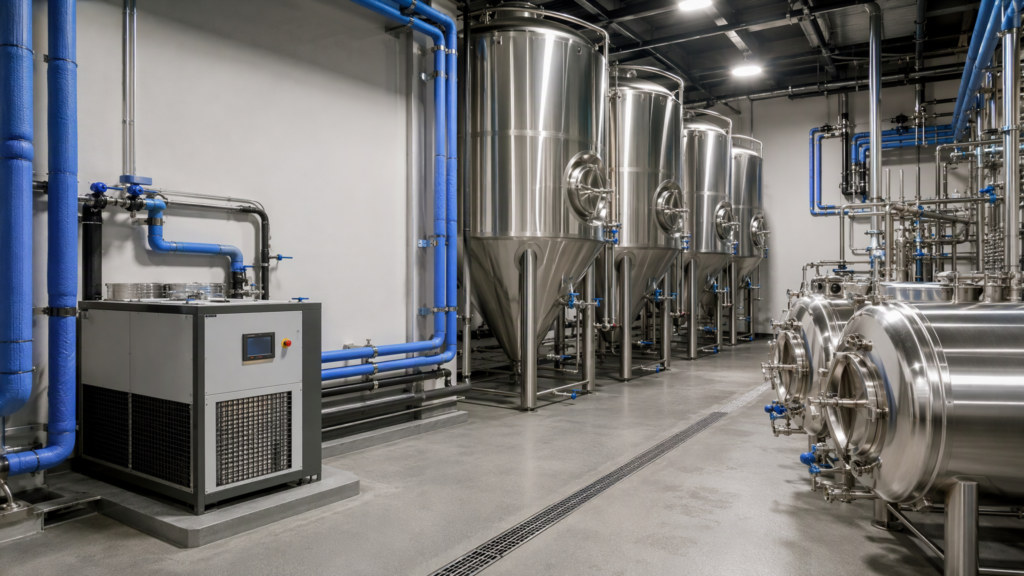
What Does a Brewery Glycol Cooling System Include?
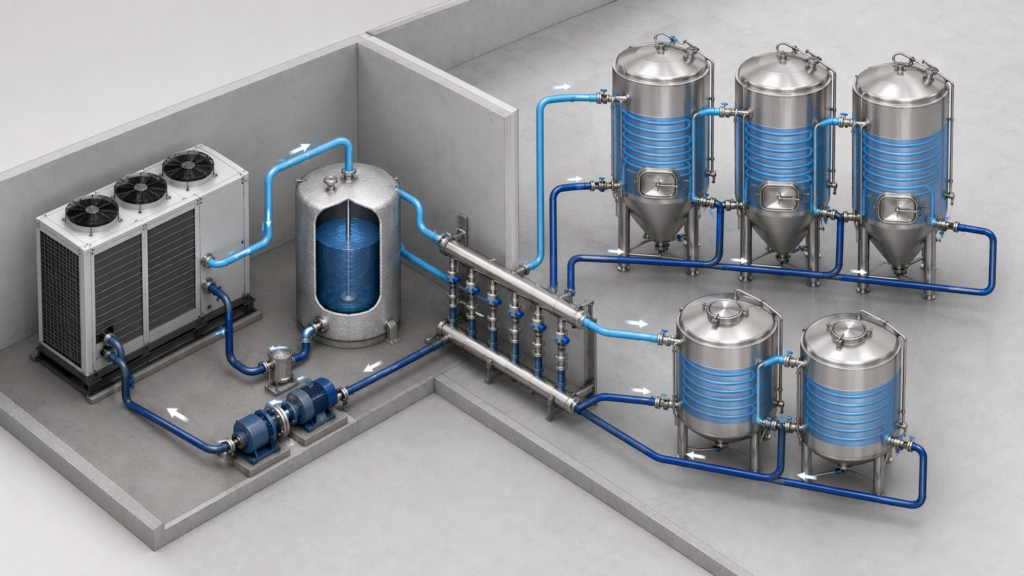
A complete brewery cooling system normally includes more than a refrigeration unit: a Glycol Chiller, reservoir or buffer tank, circulation pump, supply and return headers, branch pipes, temperature control valves, sensors, a control panel, insulation, and connections for future cooling zones.
A quotation that lists only “one glycol chiller” is not detailed enough. Ask the supplier to identify every component, its capacity, and whether it is included or excluded.
Start with the Brewery Production Schedule
The correct cooling system depends on how the brewery will operate. Begin by preparing a simple equipment and production brief before requesting a quotation.
| Information to provide | Why it matters |
|---|---|
| Number of Fermentation Tanks | Shows how many vessels may require cooling at the same time |
| Working volume of each tank | Indicates the actual beer volume, not just the outside tank size |
| Number of Bright Tanks | Defines the additional holding and packaging cooling demand |
| Batch frequency | Shows how often warm wort and beer enter the cellar |
| Fermentation temperature range | Determines the temperature-control requirement |
| Cold-crash requirement | Shows whether the system must cool one or several tanks rapidly |
| Packaging schedule | Indicates how long beer may remain in a Bright Tank |
| Building location and ambient conditions | Influences chiller performance and heat gain |
| Future expansion plan | Helps reserve chiller capacity, connections, and space |
The key question is not “How many liters are in all the tanks?” It is “How many tanks may need active cooling during the busiest normal production period?” Ten tanks may need intensive cooling on only four at once; a smaller cellar may create a higher peak if its schedule is tight.
Fermentation Tanks and Bright Tanks Do Different Cooling Jobs
A Fermentation Tank usually has the most variable cooling demand. During active fermentation, yeast generates heat and the tank temperature must be controlled continuously. After fermentation slows, the demand changes. Cold crashing can create another period of high demand because the beer must be reduced to a lower temperature before clarification or transfer.
A Bright Tank normally holds finished beer at a low and stable temperature. However, its cooling requirement can increase when warmer beer is transferred into the vessel. The tank may also need to remain cold during carbonation, clarification, and packaging preparation.
| Tank type | Main cooling purpose | What to confirm with the supplier |
|---|---|---|
| Fermentation Tank | Control fermentation temperature and support cold crashing | Jacket coverage, sensor position, control valve, and expected cooling performance |
| Bright Tank | Hold, carbonate, and prepare finished beer for packaging | Jacket coverage, pressure service, carbonation fittings, and holding temperature |
| Unitank | Ferment and condition beer in the same vessel | Whether the jacket, fittings, controls, and pressure rating support both jobs |
Do not assume that the same jacket arrangement is ideal for every tank. Ask the supplier to explain how the cooling surface is distributed and which areas are controlled independently.
How to Select the Glycol Chiller
The chiller should be selected from the brewery’s peak operating condition, not from the total nominal volume alone. Request a written statement showing which tanks can cool simultaneously and under what conditions the quoted capacity applies.
When comparing glycol chillers, check:
- Rated cooling capacity under the proposed glycol supply temperature
- Ambient temperature used for the rating
- Refrigerant and compressor configuration
- Required electrical power and voltage
- Glycol supply and return temperature range
- Recovery time after a high-demand cooling period
- Control method and alarm functions
- Outdoor or indoor installation requirements
- Noise, ventilation, and drainage requirements
- Spare capacity for planned future tanks
A supplier should explain whether the capacity covers fermentation control, cold crashing, Bright Tank holding, or all three. Without these assumptions, two apparently similar chillers cannot be compared fairly.
A very large chiller is not automatically the best choice. Excess capacity may increase the purchase price and create inefficient short operating cycles. A system that is too small may cool slowly, struggle during warm weather, or fail to maintain stable tank temperatures when several vessels are active.
Check the Tank Jacket and Insulation
The chiller cannot perform well if the tank cooling surface is inadequate. Tank construction should therefore be reviewed together with the glycol system.
Ask for the following information for each tank:
- Jacket type and coverage area
- Jacket zones and independent control points
- Design pressure of the glycol jacket
- Recommended glycol flow
- Connection size and location
- Insulation material and thickness
- Temperature sensor position
- Maximum recommended cooling duty
Tank insulation is equally important. Poor insulation increases heat gain from the brewery room and makes the cooling system run more often. Check whether the tank body, cone, manway area, fittings, and exposed pipework are insulated appropriately for the intended temperature range.
A quotation should distinguish nominal and working capacity. Discuss cooling using the actual beer volume, normal filling level, and fermentation headspace.
Check the Glycol Reservoir and Pump Package
The Glycol Reservoir stores the cooling medium and helps the system respond when several valves open at the same time. It also provides the pump with a stable supply of glycol. The reservoir is not a substitute for an adequately sized chiller, but it is an important part of system stability.
When comparing reservoir packages, confirm:
- Working and total reservoir volume
- Insulation and cover design
- Glycol expansion allowance
- Low-level protection
- Drain and filling connections
- Cleaning and maintenance access
- Compatibility with future cooling branches
The pump must deliver enough glycol to the active tank jackets, including the tank farthest from the chiller. Ask the supplier to state the expected flow, pump pressure, pipe diameter, and pressure-loss assumptions. A system with a suitable chiller but undersized distribution pipes may still produce uneven cooling between tanks.
A commercial installation should include isolation valves, control valves, balancing provisions, and clear supply and return headers. These details allow one tank to be serviced without shutting down the cellar.
How Many Tanks Should Cool at the Same Time?
This is one of the most important questions in glycol cooling system sizing. Prepare a simple operating scenario for the supplier instead of relying on a single tank count.
For example, describe whether the system may need to support:
- One tank beginning active fermentation
- Several tanks holding fermentation temperature
- One tank undergoing cold crash
- One Bright Tank receiving beer
- Another Bright Tank holding beer for packaging
- Additional heat from a wort or water cooling process, if connected
The supplier should confirm whether the proposed chiller and pump package can support that combination. If future tanks are planned, ask whether the initial system can accept extra branches or needs a larger chiller from the beginning.
The same principle appears in MICET’s 20BBL UK fermentation and Bright Tank project. The system paired 20BBL working vessels with 25BBL total volume, glycol jackets, PT100 sensors, CIP spray balls, and sanitary piping. It connects tank capacity, cooling, temperature monitoring, cleaning, and Bright Tank storage in one specification.
Compare Glycol Systems in the Same RFQ
When several suppliers quote different systems, send all of them the same technical brief. Your RFQ should include:
- Project location and ambient conditions
- Tank list with working volumes
- Fermentation and Bright Tank temperatures
- Expected cold-crash use
- Maximum number of simultaneously active tanks
- Chiller installation location
- Electrical supply and frequency
- Required glycol type and freeze protection
- Pipe distance and approximate layout
- Future tank expansion
- Installation, commissioning, and training requirements
When comparing quotations, mark every item as Included, Excluded, or Clarification Required. This prevents a low quotation from appearing better only because pumps, pipework, valves, or controls were left out. Confirm the chiller rating and test condition, simultaneous cooling zones, glycol temperatures, reservoir volume, pump flow and pressure, tank-jacket compatibility, control valves and sensors, piping scope, expansion provision, commissioning, warranty, and spare parts.
Common Glycol Cooling Selection Mistakes
Selecting only by total tank volume
Total volume is useful background information, but it does not describe the production schedule or peak simultaneous cooling demand.
Comparing chiller capacity without its test conditions
Cooling capacity changes with ambient temperature, glycol temperature, and operating conditions. Always compare the same conditions.
Ignoring Bright Tanks
Bright Tanks may require stable low-temperature holding and may receive beer before it has reached the final packaging temperature. They should be included in the operating scenario.
Buying a chiller before confirming the tank jackets
Tank jacket area, connection size, insulation, and recommended flow affect the real cooling performance.
Leaving installation scope unclear
Confirm who supplies the headers, sanitary fittings, electrical work, glycol filling, insulation, commissioning, and operator training.
Having no expansion plan
If more tanks are likely to be added, reserve space, branch connections, control capacity, and suitable chiller capacity before the cellar is installed.
Glycol Cooling System Sizing Checklist
Before approving the quotation, confirm that it includes:
- Working volume for every Fermentation Tank and Bright Tank
- Maximum number of simultaneously active cooling zones
- Fermentation, holding, and cold-crash requirements
- Chiller rating and test conditions
- Glycol supply and return temperatures
- Reservoir working volume and insulation
- Pump flow, pressure, and distribution piping
- Tank jacket coverage and connection details
- Temperature sensors, valves, and control panel
- Electrical and ventilation requirements
- Future expansion provisions
- Installation, commissioning, FAT or inspection scope
- Warranty, spare parts, manuals, and training
Conclusion
Good glycol cooling system sizing is a specification and comparison exercise, not simply a calculation based on the total liters of beer in a brewery. Start with the production schedule, identify which Fermentation Tanks and Bright Tanks may cool at the same time, then compare the chiller, reservoir, pump, tank jackets, controls, insulation, and installation scope as one connected system.
A clear RFQ makes missing components and unrealistic assumptions easier to identify before manufacturing. The best system matches the brewery’s operating pattern, provides stable temperature control, and leaves a practical path for expansion.