
Nancy Shang | Founder & CEO, MICET | Published September 10, 2026
Choosing a fermentation tank manufacturer means checking whether a company fabricates the vessel itself or resells someone else’s build under its own label. This guide walks through the specific checks — certification, material sourcing, and lead time verification — that tell the two apart.
Manufacturer certifications, pricing, and production capacity change over time, so treat the evaluation steps below as the framework and confirm current figures directly with any vendor you’re considering.

The Manufacturer vs. Reseller Problem
A fermentation tank listing with attractive pricing and a fast quote turnaround can come from either a factory or a trading company that sources from several factories and adds a markup. Both can deliver a working tank. The difference shows up later — in whether the seller can answer a welding-standard question specifically, whether spare parts match your exact unit, and who’s accountable if a weld fails under pressure two years in.
None of that is visible on a spec sheet. It surfaces through the verification steps below.
Seven Checks Before You Sign
- Ask for the factory address and request photos or video of your specific tank on the production floor. A reseller can show you a factory’s marketing photos. A manufacturer can show you your serial number on a fabrication line.
- Request the exact certificate number, issuing body, and validity date for any compliance claim. “CE certified” without a certificate number is a starting point for verification, not proof by itself — a real certificate has a specific number you can cross-check against the issuing body’s records.
- Confirm the material grade in writing — 304 versus 304/316 stainless — and ask what it’s based on. Fermentation tanks for standard beer production typically use SUS304; some kombucha, wine, or high-acidity applications call for 316 depending on product chemistry. A vendor who can’t explain why they spec one over the other for your application is guessing.
- Ask for a documented lead time with a penalty or adjustment clause if it slips. A verbal “6 to 8 weeks” with no contractual backing tells you less than a written lead time tied to your specific vessel count and configuration.
- Check welding standard and thickness specifications against your pressure and temperature requirements. Ask specifically what welding method is used — TIG welding is standard for food-grade stainless fabrication — and request the shell thickness in millimeters, not a general “heavy-duty” description.
- Request references or documented installations in your country or a comparable market. A manufacturer with installations in your climate and regulatory environment has already solved import, customs, and site-commissioning problems specific to that route.
- Verify after-sales support structure before, not after, the tank ships. Ask whether support means a phone consultation, a remote video walkthrough, or an on-site technician dispatch, and get response-time commitments in writing.
Red Flags That Separate Resellers From Manufacturers
Beyond the seven checks above, a handful of signals show up repeatedly when a seller is reselling rather than fabricating:
- Reluctance to name the specific factory location or provide a factory tour option, even virtually.
- Certification claims that name a directive (“meets CE requirements”) without a certificate number or issuing body attached.
- Material grade descriptions using vague terms like “high-quality stainless” instead of a specific SUS304 or 304/316 designation.
- Pricing that varies significantly between quotes for the same specification, suggesting the seller is shopping your order to different actual fabricators.
- No documented welding standard when asked directly — a real fabricator can state this without checking with someone else first.
Fermentation Tank vs. Reseller Evaluation Table
| Evaluation Point | Direct Manufacturer | Typical Reseller Pattern |
| Factory verification | Photos/video of your specific unit on the line | Generic marketing photos, not tied to your order |
| Certification documentation | Certificate number, issuing body, validity date provided on request | Claims a directive is met, no certificate number offered |
| Material grade specificity | States SUS304 or 304/316 with reasoning tied to your application | Uses general terms like “food-grade stainless” |
| Lead time | Written, tied to your configuration | Verbal estimate, often optimistic |
| Welding standard | Named specifically (e.g., TIG welding, shell thickness in mm) | Not volunteered unless pressed |
| Pricing consistency | Stable across repeated quote requests | Fluctuates between quotes for identical specs |
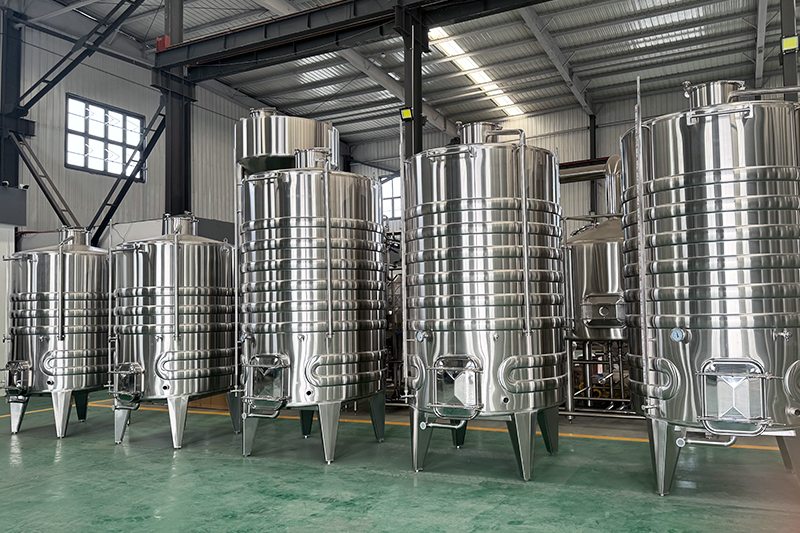
What to Ask For: MICET Fermentation Tank Specifications
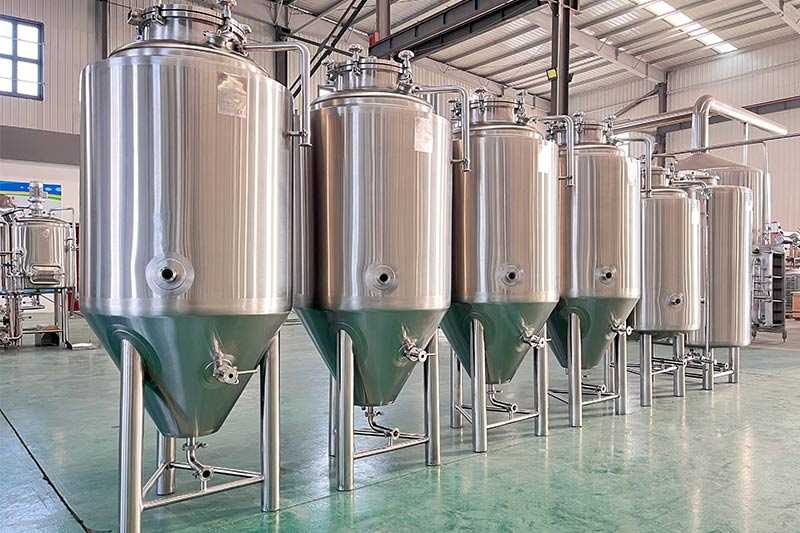
When you’re comparing our fermentation tanks against another manufacturer’s line, ask for the same level of specificity we’d expect any buyer to request. Our fermentation tanks are built in SUS304 stainless (304/316 available for specific applications) across a published range of 500L, 600L, 700L, 800L, 1,000L, and 2,000L, up through 40BBL and 60BBL for larger operations. Every tank ships as a cylindrical-conical vessel with a glycol jacket, pressure-reducing valve, and CIP cleaning nozzle as standard equipment, not a paid add-on.
Standalone fermentation tank pricing isn’t listed as a published band in our resource library the way our brewhouse packages are — a specific quote depends on volume, jacket zoning, and material grade, so this is one to request directly rather than expect off a spec sheet.
A Common Misconception: Certification Names Alone Mean Compliance
The most common mistake craft brewery owners make in this evaluation is treating a certification name — “CE,” “PED compliant” — as sufficient on its own. It isn’t. A CE mark can reflect a manufacturer’s self-declaration, which is a legitimate but different category of claim than third-party verification. The distinction matters because a self-declared conformity statement means the manufacturer checked its own work; a third-party certificate means an outside accredited body reviewed the technical file independently.
For pressure vessels specifically, that third-party layer falls under the EU’s Pressure Equipment Directive (2014/68/EU). Our brewery and fermentation equipment has passed Verification of Conformity under certificate ICR/VC/HM2507146, issued by ICR Co., Ltd. on July 16, 2025 and valid through July 15, 2030, confirming compliance against EN 1626:2008 and EN 10204:2004. Ask any manufacturer you’re evaluating for the equivalent — a real certificate number, not just a claim.
A second edge case worth flagging: a manufacturer can legitimately subcontract certain fabrication steps — polishing, final assembly, or electrical control panel wiring — without being a “reseller” in the problematic sense. The question isn’t whether every single step happens under one roof; it’s whether the company can answer specific technical questions about your tank’s construction without redirecting you to a third party they don’t control.
Compared to the used-equipment marketplaces and broad supplier directories that dominate search results on this topic, few sources walk buyers through the specific documentation to request during vendor evaluation — most stop at “check reviews” without naming what a real certificate or lead-time commitment looks like.
FAQ
Q: How can I tell if a company is a real manufacturer versus a trading company?
A: Ask for factory photos or video of your specific tank on the production line, request the exact factory address, and ask if a virtual or in-person tour is possible. A trading company typically can’t produce order-specific documentation the way a fabricator can.
Q: Does a CE mark guarantee the same thing as a PED certificate?
A: No. A CE mark can be a manufacturer’s own declaration of conformity to a directive’s requirements. A PED certificate from an accredited third-party body means an outside organization independently verified the technical documentation — a stronger form of assurance.
Q: What material grade should I ask for on a beer fermentation tank?
A: SUS304 stainless is standard for beer fermentation. Some kombucha, wine, or high-acidity applications benefit from 304/316 — ask the manufacturer to explain their recommendation for your specific product rather than accepting a default answer.
Q: How much should lead time vary between manufacturers for the same tank spec?
A: This depends on current production capacity and order backlog, which shifts over time — get a written lead time tied to your specific configuration rather than comparing verbal estimates across vendors.
Q: Is a lower price from a reseller ever the right choice?
A: It can be, particularly for a single small tank where the accountability gap matters less. For a multi-tank commercial order, the coordination and warranty clarity of working directly with a fabricator usually outweighs a modest price difference.
Q: What welding standard should I expect for food-grade stainless fermentation tanks?
A: TIG welding is standard for food-grade stainless fabrication. Ask for the specific shell thickness in millimeters and the welding method by name — a manufacturer should answer this without checking with someone else.