
A small jar may work when you first brew kombucha, but commercial growth changes everything. More orders mean more batches, more cleaning, more transfers, and more chances for inconsistent fermentation. The wrong vessel can quickly become the bottleneck that limits production.
A kombucha brewing vessel is the container where sweetened tea, starter liquid, and a SCOBY ferment into kombucha. A glass jar works for pilot batches, while commercial kombucha brewing normally requires sanitary stainless steel tanks with suitable airflow, temperature control, cleanable surfaces, drainage, sampling points, and enough working volume to support repeatable production.

For a growing beverage business, choosing the right vessel is not simply about buying a bigger container. You need to think about fermentation behavior, batch scheduling, cleaning, factory layout, future capacity, and how the vessel connects with blending, cooling, filtration, carbonation, and filling.
As a manufacturer of commercial beverage and brewery equipment, we approach this question from the production side: What vessel design will help you make the same product safely and efficiently every week?
1. Why Does a Glass Jar Work for a Small Brew but Become Difficult at Commercial Scale?
A glass jar is one of the easiest ways to start making kombucha. A home brewer may use a 1 gallon container, a gallon glass vessel, or a simple wide-mouth glass container. Tea is prepared, sugar is dissolved, starter is added, and the SCOBY is placed on the surface.
For a small batch, this simple setup makes sense. You can see the liquid, inspect the SCOBY, and clean the container manually. A glass jar with spigot can even act as a basic brew dispenser, allowing a user to draw a small amount without lifting the vessel.
The challenge appears when one gallon becomes hundreds or thousands of liters.
Imagine trying to run commercial production with dozens or hundreds of small jars. Your team would need to:
- Prepare every batch of kombucha separately
- Carry and clean many containers
- Record fermentation conditions for each one
- Handle the SCOBY many times
- Open and close many vessels
- Transfer finished kombucha manually
- Control temperature across different containers
- Keep contamination risks under control
That labor adds up quickly.
This is why a consumer kombucha brewing jar, a kombucha jar, or a home kombucha kit should not be viewed as a direct substitute for commercial equipment.
Searches for products such as Kitchentoolz, Kombucha Kamp, a brewing jar by Mortier Pilon, or a continuous brewer deluxe package generally relate to household or very small-scale brewing. They may be useful for testing recipes, but commercial beverage production has a very different operating environment.
2. What Makes a Commercial Kombucha Brewing Vessel Different?
A commercial brewing vessel needs to do more than hold tea.
When we design equipment for professional producers, we look at the entire brewing process. The tank should support fermentation while also making filling, draining, sampling, temperature management, cleaning, and production scheduling easier.
Typical commercial vessel requirements may include:
| Feature | Small Brewing Container | Commercial Stainless Steel Vessel |
|---|---|---|
| Capacity | 1–2 gallon | Hundreds to thousands of liters |
| Cleaning | Manual | CIP-compatible design |
| Temperature control | Room temperature | Jacketed cooling/heating available |
| Sampling | Open vessel | Sanitary sampling valve |
| Drainage | Pour or spigot | Sanitary bottom/outlet valve |
| Material | Glass | Food-grade 304/316 stainless steel |
| Monitoring | Manual | Temperature and process instrumentation |
| Installation | Countertop | Integrated production layout |
| Scale-up | Add more jars | Add or resize process tanks |
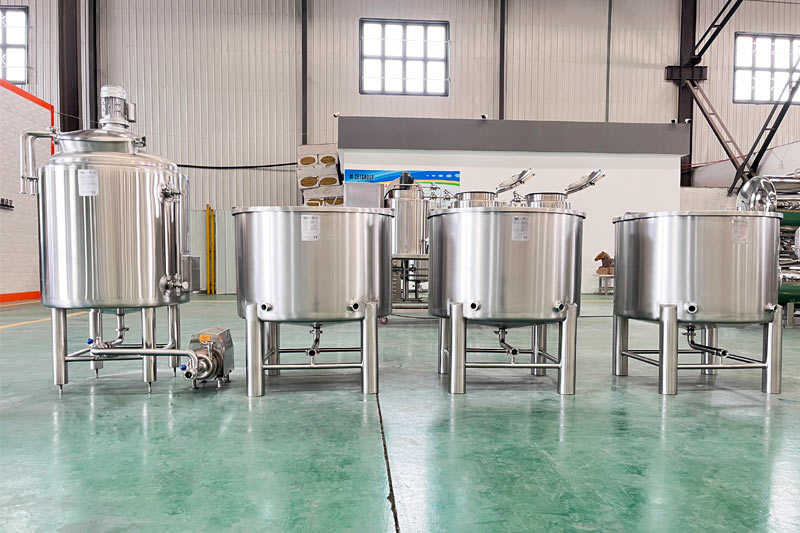
MICET’s current commercial kombucha fermenter range, for example, lists 100 L to 3000 L manufacturing capacities and food-grade 304/316 stainless steel configurations, with sanitary fittings and CIP spray coverage available.
For growing beverage companies, those design details affect labor just as much as they affect the beverage itself.
A proper fermentation vessel also needs to match what happens before and after fermentation. There is little value in installing a large tank if your tea preparation system, cooling capacity, pumps, flavoring tank, or filling line cannot keep up.
3. Batch Brew vs. Continuous Brew: Which Brewing Method Fits Commercial Production?
A batch brew is simple: prepare tea, inoculate it, allow it to ferment, transfer the product, clean the vessel, and start again.
A small operator may batch brew kombucha in a jar. Commercial producers can follow the same basic biological principle, but they typically use much larger process tanks.
A continuous brew approach works differently. Part of the fermented liquid stays in the vessel while some product is removed and fresh sweet tea is added. This approach is popular among people making kombucha at home because it reduces how often the vessel must be completely restarted.
A basic continuous brew system may therefore include a vessel with a spigot, allowing the user to open the spigot, draw kombucha, and replenish the tea.
However, commercial production needs more careful process control.
Batch Brew
Advantages:
- Easier batch traceability
- Clear start and finish times
- Easier recipe changes
- More predictable cleaning schedule
- Better separation between different flavors or SKUs
Continuous Brew Kombucha
Potential advantages:
- Culture remains active
- Less frequent full restart
- Can support frequent product withdrawal
Potential challenges:
- Harder lot identification
- Greater process-control demands
- Culture balance may shift over time
- Cleaning schedules become more complicated
- Product consistency must be monitored carefully
A household continuous kombucha system and industrial production should therefore not be treated as the same thing.
For many beverage manufacturers, separate fermentation batches provide better production planning. A professionally engineered continuous kombucha brewing process can still be developed, but tank turnover, culture management, sanitation, traceability, and downstream packaging all need to be considered together.

4. How Large Should Your Kombucha Brewer Be?
Do not choose tank capacity only by asking, “How much do I want to sell?”
Ask instead:
How much product must leave the factory each week, and how long will each tank remain occupied?
Kombucha fermentation commonly takes several days, and fermentation time changes with culture, formulation, temperature, and target flavor. Scientific literature describes kombucha fermentation commonly occurring across roughly 7–10 days in many processes, while other studies evaluate longer cycles depending on temperature and product design.
This means tank occupancy matters.
A useful planning equation is:
Approximate weekly fermentation capacity = vessel working volume × number of vessels × 7 ÷ average fermentation days × planned utilization
For example, consider an illustrative plant with:
- Six 1000 L vessels
- 10-day average tank cycle
- 90% practical utilization
Approximate output:
1,000 × 6 × 7 ÷ 10 × 0.90 = 3,780 L/week
This is only a planning example. Actual production depends on recipe, downtime, cleaning, starter ratios, secondary processing, and tank scheduling.
Illustrative Scale Progression
Home test          1 gallon       █
Pilot test         20–100 L       ███
Startup            200–500 L      ██████
Commercial         1,000 L        ███████████
Expanded plant     Multiple tanks █████████████████
A 2 gallon jar or one gallon trial can help prove a recipe. It cannot tell you how many commercial fermenters you need until you also define your production calendar.
This is why our engineering approach starts with required output, fermentation time, SKU count, factory space, and future growth—not tank volume alone.
5. Glass Vessel or Stainless Steel: Which Material Is Better for Commercial Kombucha Brewing?
Glass has one important advantage: it is easy to inspect.
For making homemade kombucha, glass kombucha brewing is convenient because you can see changes in the liquid and SCOBY directly. Glass is also non-reactive when used correctly.
But glass becomes difficult at scale.
A large glass vessel is fragile, heavy, awkward to move, difficult to integrate with industrial piping, and less practical for automated cleaning.
For that reason, food-grade stainless steel is widely used when producers scale up.
Research literature describing kombucha production notes that fermentation can be carried out in suitable glass or stainless steel containers, with oxygen access remaining important during the aerobic stage.
Why Stainless Steel Fits Commercial Production
Food-grade stainless steel can provide:
- Strong mechanical durability
- Smooth sanitary product-contact surfaces
- Compatibility with CIP cleaning
- Sanitary valves and fittings
- Cooling or heating jackets
- Temperature sensors
- Controlled drainage
- Easy integration with pumps and pipelines
MICET commercial kombucha tanks can be manufactured using food-grade 304 or 316 stainless steel, depending on project requirements.
For certain very small producers, stainless steel may seem like an expensive alternative to glass. At commercial scale, however, durability, sanitation, maintenance, and process integration usually matter more than the initial simplicity of a jar.
In that context, stainless steel is not merely a reasonable alternative to glass. It becomes part of the production infrastructure.
6. How Do SCOBY, Starter and Sweet Tea Affect Vessel Design?
Kombucha is not fermented exactly like beer.
The SCOBY—the symbiotic culture of bacteria and yeast—interacts with oxygen, sugar, temperature, tea composition, and the geometry of the vessel.
During primary fermentation, yeasts and bacteria transform the sweet tea into an acidic fermented beverage. Research consistently shows that pH decreases as kombucha ferments and organic acids develop.
That means vessel design should consider more than capacity.
For example:
- How will the operator add the starter?
- How will the SCOBY enter and leave the vessel?
- Does the process require an open or semi-open fermentation stage?
- How will tea residue be removed?
- How will operators sample the liquid?
- Where will the SCOBY be transferred between batches?
- Will the tank later be closed for cooling or conditioning?
A small kombucha brewer can simply lift a cloth cover.
A commercial plant needs a repeatable procedure.
If a producer uses kombucha starter cultures across several tanks, vessel access and culture transfer should be designed into the production workflow from the beginning.
The same applies to a so-called kombucha mamma, or mother culture. At production scale, culture handling becomes an operating procedure rather than a casual kitchen step.
7. Why Do Temperature Control and Sanitary Cleaning Matter So Much?
Once you start producing hundreds of liters, environmental variation becomes expensive.
Temperature influences how quickly kombucha ferments and how acidity develops. A recent controlled study comparing 23°C, 25°C, and 28°C across different fermentation periods found that temperature and time affected pH and organic acid development.
For commercial production, a jacketed vessel can make temperature management more predictable.
The same principle applies to cleaning.
A home brewing container may be washed by hand. Commercial brewing equipment should allow operators to clean internal surfaces consistently without climbing inside the tank or relying on improvised tools.
Useful sanitary features can include:
- CIP spray devices
- Smooth internal surfaces
- Sanitary tri-clamp connections
- Drainable piping
- Sanitary sample valves
- Accessible manways
- Temperature sensors
- Suitable outlet positioning
MICET’s kombucha fermenter designs list 360° CIP spray coverage, sanitary sampling valves, temperature sensing, adjustable legs, cooling jackets, and other configurable features.
A clean tank also supports flavor consistency. Residue from a previous batch can influence acidity, aroma, or microbial activity in the next one.
8. What Happens After the First Fermentation?
Many first-time producers focus almost entirely on the primary tank.
But primary fermenting kombucha is only part of a commercial line.
Depending on the product, the beverage may later move through:
- Tea preparation
- Primary fermentation
- Flavor blending
- Filtration
- Cooling
- Carbonation
- 2nd fermentation
- Buffer or holding tanks
- Bottle, can, or keg filling
- Cold storage
If you want flavored kombucha, for example, you may not want fruit or flavor solids passing through the same vessel and piping used for every base product.
If you plan to sell kombucha on tap, keg handling and carbonation become part of the design.
If you produce a carbonated packaged product, the process after primary fermentation can affect both quality and regulatory control.
In the United States, TTB states that kombucha reaching 0.5% alcohol by volume or more at any point during production, at bottling, or after bottling due to continued fermentation can fall under federal alcohol beverage requirements.
That is an important commercial issue.
A producer should therefore think beyond “How do I make kombucha?” and ask:
How will I control the beverage from starter tank to final package?
9. How Do You Scale From Batch Brew Kombucha to a Complete Production Line?
The safest way to scale is not to multiply your old setup blindly.
Suppose you currently make 1 gallon kombucha or a few gallon batches. You might prepare a gallon of sweet tea, add your culture, wait, bottle it, and then start again.
That process proves your recipe.
It does not automatically define your factory.
Before you start brewing commercially, document:
Product Requirements
- Target daily and weekly output
- Number of flavors
- Fermentation duration
- Target acidity
- Carbonated or still product
- Packaging format
Facility Requirements
- Available floor area
- Ceiling height
- Drain position
- Water supply
- Electrical power
- Glycol system requirements
- Cleaning area
- Cold storage
Process Requirements
- Tea preparation method
- Number of fermentation tanks
- Culture-handling process
- Flavor blending
- Filtration
- Carbonation
- Filling
A real project may require more than one fermentation station.
For example, MICET has supplied turnkey kombucha projects that combine tea brewing, fermentation, filtration, cooling, cleaning, and filling rather than treating the fermenter as an isolated machine.
That is also why a consumer continuous brew package, deluxe kombucha kit, or small-batch appliance should not drive the equipment specification for a growing beverage plant.
10. What Are the Most Common Kombucha Brewing Vessel Mistakes?
Choosing Capacity Without Calculating Tank Turnover
Buying a 1000 L tank does not mean you can ship 1000 L every day.
Fermentation occupies the vessel for days. Cleaning and preparation take more time.
Designing Around the Tank Instead of the Process
Your kettle, cooling system, fermentation tanks, blending tanks, pumps, and filling machine need balanced capacities.
Ignoring Cleaning Access
A poorly designed outlet, dead leg, inaccessible fitting, or difficult-to-clean surface becomes more serious as production increases.
Treating Commercial Production Like Making Kombucha at Home
The biology is similar. Operations are not.
A commercial facility needs repeatability, documented cleaning, batch records, stable utility supply, and production planning.
Assuming Continuous Brewing Is Automatically More Efficient
A kombucha continuous brew arrangement may reduce restart frequency, but efficiency depends on product strategy, sanitation, traceability, and downstream operations.
For many brands producing several flavors, kombucha in single batches may provide simpler SKU control.
Buying Equipment Before Planning Expansion
A good plant should leave room for more fermentation tanks, additional cooling demand, and future packaging capacity.
When we prepare a customized kombucha system, we prefer to discuss the next production stage early. Moving a wall or rebuilding a glycol system later is far more disruptive than planning expansion from the start.
Frequently Asked Questions
What is the best vessel to brew kombucha commercially?
For commercial production, food-grade stainless steel is generally the most practical choice because it is strong, sanitary, cleanable, and easy to integrate with piping, temperature control, CIP systems, and downstream processing.
A small jar remains useful for recipe trials and culture work.
Can I use a glass fermentation vessel for commercial kombucha?
A glass fermentation vessel can work for pilot batches, but scaling glass to industrial volumes creates handling, breakage, sanitation, and process-integration problems.
Commercial producers usually move toward stainless steel as output grows.
Is batch brew better than continuous brewing vessels?
Neither method is automatically better.
Continuous brewing vessels can support frequent product withdrawal, while the batch brew method usually provides clearer batch tracking, cleaning cycles, recipe changes, and SKU management.
Your best choice depends on product range and production strategy.
Do I need a spigot on a commercial kombucha tank?
A small spigot is common on household brewing systems, but commercial tanks normally use sanitary valves and process connections.
The outlet should match the required flow rate, cleaning method, pump connection, and transfer process.
Can I scale directly from a 1-gallon jar to a 1000 L tank?
You can scale the recipe, but you should not assume that every process condition scales in a straight line.
Heat transfer, oxygen exposure, culture behavior, mixing, cooling, tank geometry, cleaning, and sampling all change with volume.
Pilot production between home scale and full commercial scale can reduce risk.
How many kombucha fermentation vessels do I need?
Start with your required weekly output and expected fermentation cycle.
Then account for cleaning time, utilization, product variations, starter management, and production peaks.
For a commercial project, we normally calculate tank quantity as part of the overall capacity plan instead of recommending a fixed number.
Key Takeaways
- A kombucha brewing vessel should be selected according to production scale, fermentation process, sanitation, and future capacity—not price alone.
- A household brewing jar is useful for recipe development but becomes labor-intensive when production grows.
- Batch brew offers simple traceability and recipe control, while a professional continuous brew process requires careful culture, sanitation, and production management.
- Food-grade stainless steel provides the durability, cleanability, sanitary fittings, and temperature-control options needed for most commercial systems.
- Your fermenter should be planned together with tea preparation, cooling, flavoring, filtration, carbonation, CIP, and filling equipment.
- Tank capacity alone does not determine output. Fermentation duration and vessel turnover are just as important.
- Commercial producers should monitor acidity, temperature, alcohol development, sanitation, and finished-product stability as part of a controlled process.
- Planning utilities, layout, tank quantity, and future expansion before equipment fabrication can reduce costly modifications later.
If you are moving from a fresh kombucha recipe developed in a jar to a scalable commercial process, the most important step is to define the production target before selecting the tank.
At MICET, we design and manufacture customized stainless steel kombucha fermentation tanks, brewing systems, and turnkey beverage lines for professional producers. Tell us your required output, fermentation cycle, available factory space, packaging method, and future expansion plan, and our engineering team can help configure a system around the way you actually intend to produce.