
Pot still vs column still is not a question of which machine looks more traditional or which one has the highest quoted capacity. It is a production-design decision. The right system must match the spirit style, fermented-liquid strength, batch schedule, target alcohol strength, available utilities, labor model, building height, and expansion plan.
A pot still is usually a better starting point for batch-made, flavor-led spirits. A column still is usually more effective when the producer needs repeatable separation, higher throughput, and a cleaner or more neutral spirit. A hybrid system can be the better answer when one distillery needs both flexibility and efficiency.
This guide explains the practical differences between the two systems and shows how a buyer can move from a product goal to a defensible equipment specification.
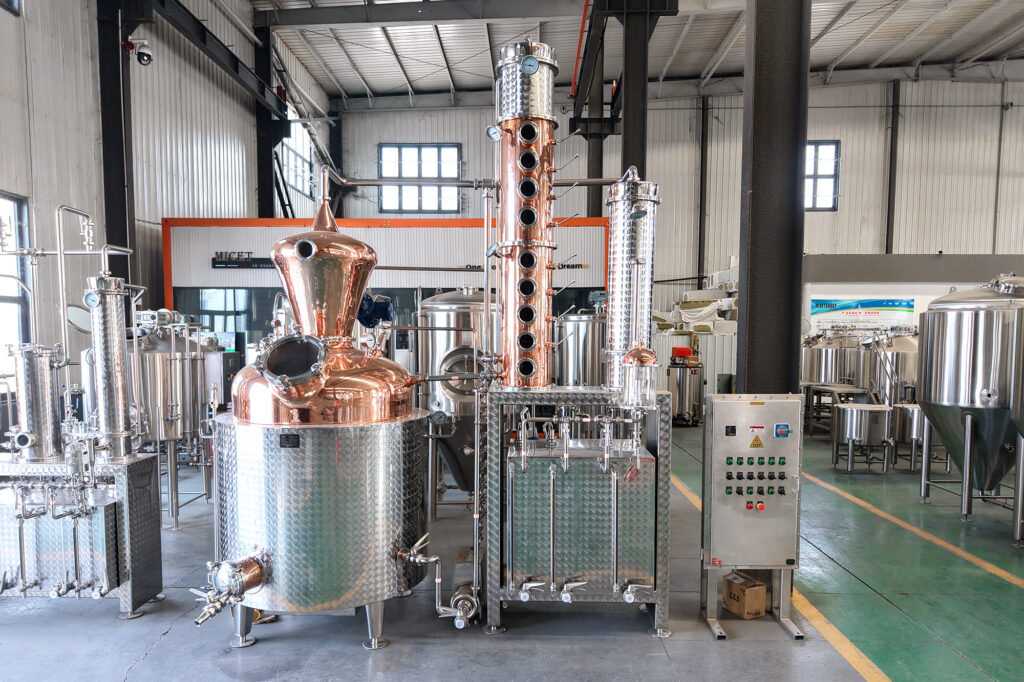
The short answer: which system should you choose?
Choose a pot still when your business depends on batch flexibility, multiple recipes, and a spirit character linked to raw materials and fermentation. Choose a column still when your priority is stable throughput, repeatable alcohol strength, and efficient production of a defined product. Consider a hybrid system when you need a batch pot still for flavor development and a column section for additional separation or rectification.
The decision becomes clearer when the question is expressed in measurable terms:
- How many liters of finished spirit must the distillery produce each month?
- What is the fermented liquid’s starting alcohol strength?
- What alcohol strength is required after distillation and before bottling?
- How much product will be retained as hearts rather than heads and tails?
- How many operating days and shifts are available?
- Can the facility support steam, cooling water, drainage, ventilation, and the height of a column?
Quick comparison
| Comparison Point | Pot Still | Column Still |
|---|---|---|
| Operating method | Batch distillation | Continuous, semi-continuous, or batch operation |
| Main strength | Flexible control over each batch | Stable throughput and repeatable separation |
| Spirit character | Often retains more raw-material and fermentation character | Can produce a cleaner, more neutral spirit when highly rectified |
| Capacity metric | Working batch volume, cycle time, and recovery | Feed flow rate, operating hours, and recovery |
| Recipe flexibility | Well suited to multiple recipes and product changes | Best suited to stable products and consistent feed conditions |
| Alcohol-strength control | Managed through heating, reflux, and collection cuts | Managed through reflux, feed rate, heat input, and column design |
| Labor and automation | More hands-on batch operation | More suitable for automated flow and process control |
| Space requirement | Usually lower vertical clearance requirements | Requires height for the column, platforms, valves, and maintenance access |
| Typical applications | Whisky, rum, brandy, and flavor-led craft spirits | Neutral spirits and higher-volume, repeatable production |
This table is a starting point rather than a substitute for process design. A pot still can be automated, and a column still can be operated in batch mode; the final result depends on the equipment configuration and operating conditions.
Pot still and column still: the process difference
How a pot still works
A pot still is a batch distillation vessel. Fermented liquid is heated, vaporized, and passed through a still head and condenser before being collected as liquid. The operator can adjust the heating rate, vapor path, condenser operation, and collection cuts during each run, making the system suitable for multiple recipes and flavor-led spirits.
The final spirit depends on the raw material, fermentation, yeast, copper contact, reflux, cut points, and maturation. A pot still provides process flexibility but does not determine the flavor on its own.
How a column still works
A column still uses trays, plates, or packing to increase vapor-liquid contact as vapor rises and liquid flows downward. It can operate continuously, semi-continuously, or in a batch process, depending on the system design.
Separation performance depends on column stages, reflux, feed rate, vapor rate, pressure, heat input, and condenser design. A taller column is not always better because it may increase cost, cleaning requirements, installation height, and control complexity. The column should be specified according to the target product and required throughput.
A practical capacity example: why vessel volume is not output
Buyers often compare a “500 L still” with a “500 L column system” as if the number directly represented finished spirit output. It does not. A useful estimate must account for fill level, feed alcohol strength, recovery, cut losses, and bottling strength.
Capacity is measured differently
| System Type | Main Capacity Metric | Example in This Article |
|---|---|---|
| Pot Still | Working batch volume, batch cycle time, and recovery | 400 L working fill from a 500 L nominal vessel |
| Column Still | Feed flow rate, operating hours, and recovery | 150 L/h of 10% ABV fermented liquid |
| Both systems | Pure alcohol balance and final product strength | Feed ABV, collection ABV, recovery, dilution, and packaging losses |
The capacity figure should also state whether it refers to fermented feed, collected distillate, hearts, diluted spirit, or packaged product. Without this definition, two quotations may use different measurement points and still appear to offer the same capacity.
Practical Capacity Example
Consider this illustrative example, not a guaranteed equipment rating:
- Nominal pot still volume: 500 L
- Working fill: 80%, or 400 L
- Feed strength: 10% ABV
- Pure alcohol in the charge: 400 L × 10% = 40 L
- Estimated recovery: 80%, or 32 L of pure alcohol
- Collected distillate: 32 ÷ 0.65 ≈ 49 L at 65% ABV
After dilution to 40% ABV, the 32 L of pure alcohol produces approximately 80 L of spirit, before transfer and packaging losses. Therefore, producing 1,000 L per month at 40% ABV would require about 12.5 equivalent 500 L batches, excluding downtime, cleaning, maintenance, and yield variation.
For a column system processing 150 L/h of 10% ABV feed, the theoretical output is 15 L of pure alcohol per hour. At 80% recovery, this equals 12 L of pure alcohol, or approximately 18.5 L/h at 65% ABV. Actual capacity depends on column design, feed stability, reflux, product specifications, and operating conditions.
Pot still vs column still: the differences that affect a business
Batch flexibility versus continuous throughput
A pot still is charged, heated, emptied, and cleaned for each batch. This provides flexible production but also creates downtime. For example, an eight-hour distillation run followed by two hours of cleaning occupies the still for ten hours.
A column still can operate for longer periods with a stable feed, improving labor and equipment utilization when demand is predictable. However, it depends on consistent upstream fermentation and feed supply. Capacity should therefore be calculated using required output and realistic operating hours, including cleaning, changeovers, maintenance, and planned downtime.
Spirit character versus degree of rectification
Pot stills are commonly used for whisky, rum, brandy, and other flavor-led spirits because operators can adjust the run and make product-specific cuts.
Column stills provide repeated vapor-liquid contact and can achieve higher rectification, making them suitable for cleaner and more consistent spirits. However, the final result depends on reflux, internal design, feed conditions, and operating parameters. Buyers should define collection strength, flavor target, acceptable variation, and whether the spirit will be redistilled or blended.
Alcohol strength and recovery
A higher alcohol reading at one point in the process does not automatically mean a higher commercial yield. Increasing separation can concentrate alcohol, but product retained in heads and tails, liquid left in the still, condenser losses, and dilution all affect saleable output.
A proper proposal should state:
- Feed volume and feed ABV;
- Expected product or hearts volume;
- Collection ABV range;
- Assumed recovery of pure alcohol;
- Whether the figure is before or after dilution;
- Expected losses during transfer, storage, and packaging.
Without these definitions, two suppliers can quote different “capacity” figures and both appear correct.
Labor and automation
A pot still can be operated manually, semi-automatically, or automatically. Its batch format supports recipe changes, but operators still need to manage charging, transfers, temperature, collection cuts, and cleaning.
A column still can automate feed flow, heat input, reflux, temperature, pressure, level, and product diversion, improving process consistency. However, automation cannot replace sound process design, trained operators, calibrated instruments, documented recipes, and safety procedures.
When reviewing a control system, confirm which values are only displayed and which are actively controlled. A displayed temperature reading is not the same as closed-loop temperature control.
Building height, utilities, and installation
The difference between the two systems is also a facility-planning issue. A column may require significant vertical clearance for the column body, platforms, valves, insulation, maintenance access, and lifting route. The buyer should confirm the usable height after deducting beams, lights, sprinklers, roof structure, and installation clearance.
Both systems require more than the still itself. The utility review should cover:
- Heating source and available capacity;
- Cooling-water or glycol flow and temperature;
- Drainage and wastewater handling;
- Ventilation and vapor management;
- Electrical supply and control-panel location;
- Access for delivery, lifting, cleaning, and maintenance.
For example, a proposal that fits the floor plan but leaves no safe access above a column is not a workable installation. A condenser selected without checking the hottest seasonal cooling-water temperature may also fail to deliver the expected performance.
When a hybrid distillation system makes sense
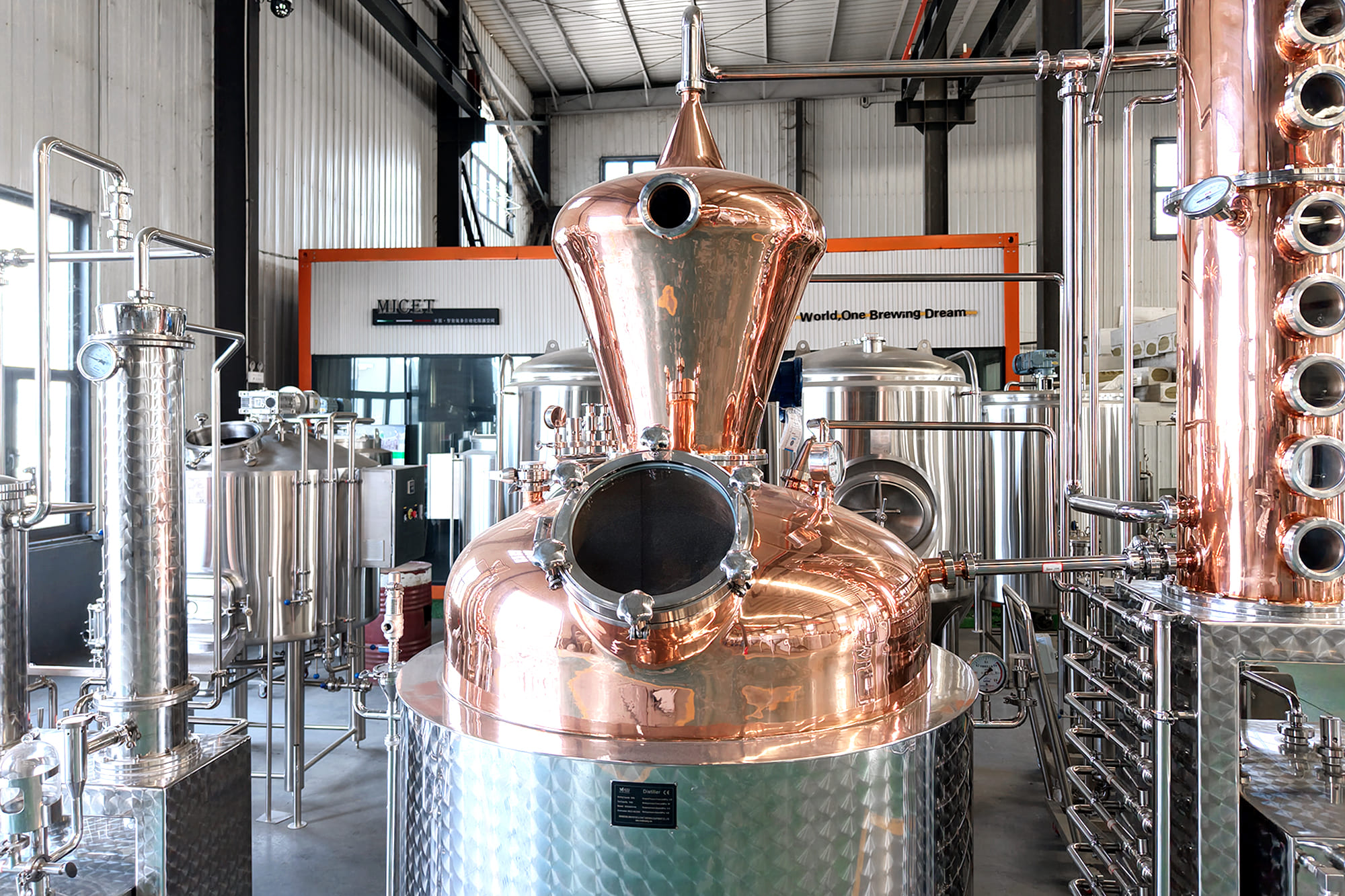
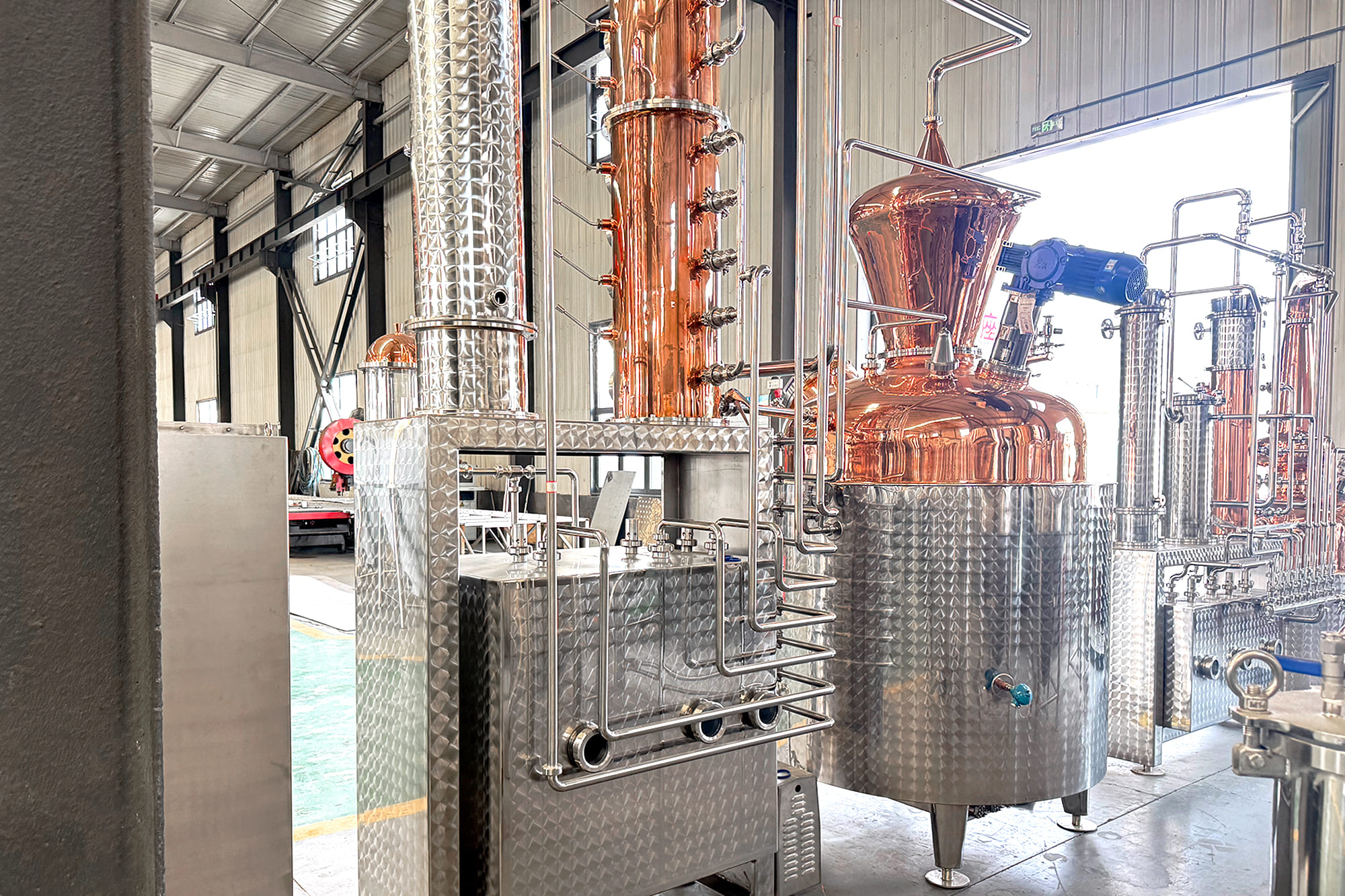
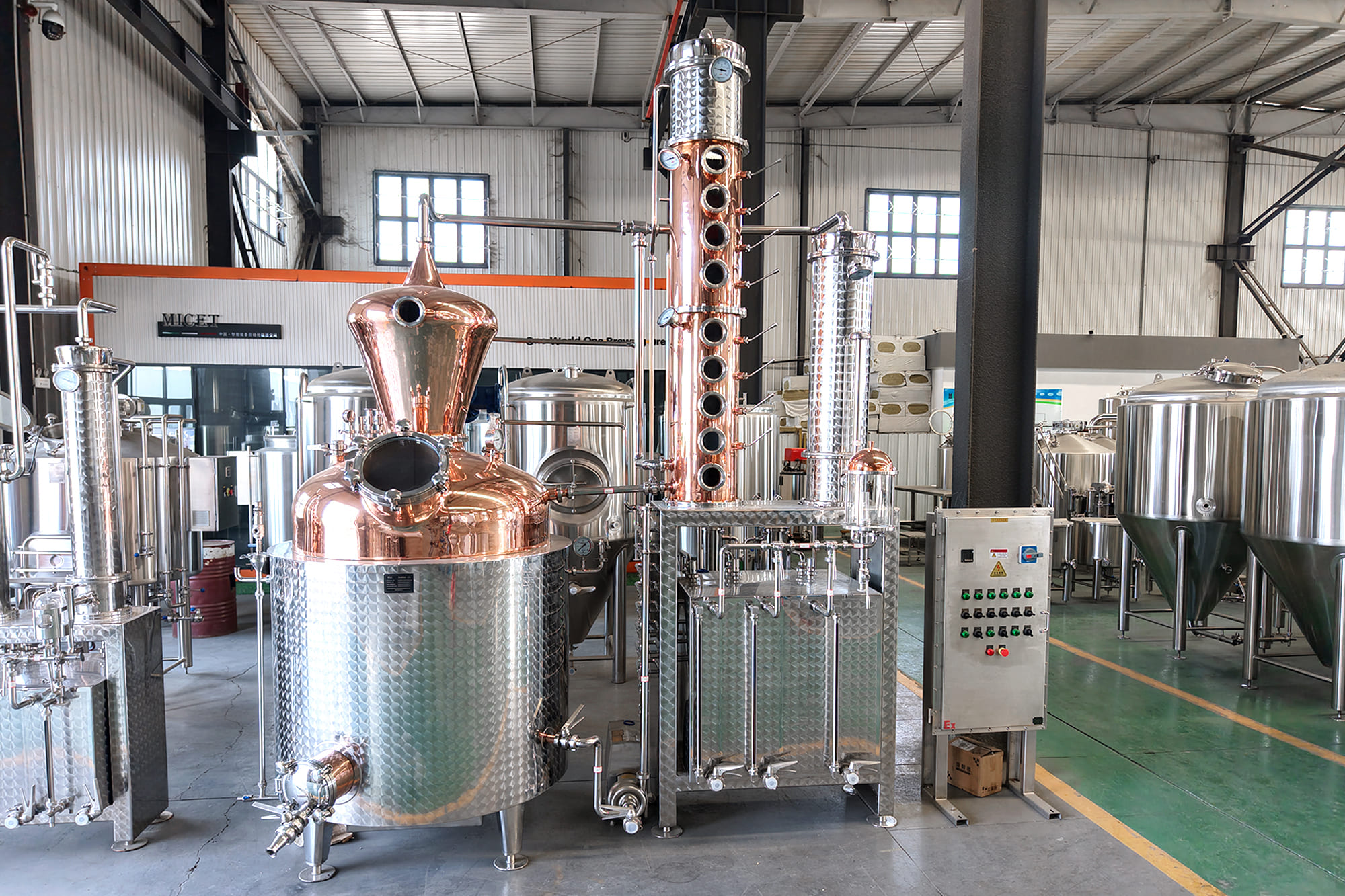
A hybrid distillation system combines a pot still with a column section or rectification column. This configuration can help producers balance batch flexibility, flavor development, and improved separation.
A typical process may be:
Fermentation tank → pot still → column section → condenser → spirit collection tank
This configuration may suit a producer that:
- Starts with flavor-led rum or whisky but wants a cleaner product option;
- Makes several spirit styles on one production platform;
- Needs to test recipes before investing in a dedicated continuous line;
- Wants a staged expansion path;
- Requires more separation than a simple pot still can provide.
The hybrid approach also introduces more decisions: column height, number and type of stages, reflux control, product diversion, cleaning access, and the operating relationship between the pot still and column. It should be selected because the process needs it, not because a larger equipment list sounds more advanced.
A buyer’s specification checklist with measurable questions
Before requesting a quotation for distillation equipment, prepare the following information:
Product and process
- Spirit type and raw material;
- Fermentation vessel volume and typical feed ABV;
- Desired collection ABV and bottling ABV;
- Required flavor profile and whether neutral spirit is needed;
- Expected hearts percentage or recovery assumption;
- Number of recipes or products to be made on the system.
Capacity and schedule
- Finished product required per month or year;
- Required liters of pure alcohol per month or year;
- Number of operating days per month;
- Planned shifts per day;
- Maximum acceptable batch or changeover time;
- Future production target after expansion.
Equipment and facility
- Nominal and working volume of the still;
- Required feed rate for a column system;
- Heating source and available utility capacity;
- Condenser duty and cooling-water conditions;
- Total installed height and maintenance clearance;
- CIP method, drainability, and access for inspection;
- Control philosophy: manual, semi-automatic, or automatic;
- Required drawings, testing records, manuals, and commissioning support.
A supplier should be able to explain how the proposed equipment turns the stated feed volume and ABV into the stated finished-product output. If the quotation gives only a vessel volume and a broad “capacity” claim, more process information is needed before comparing prices.
What should a commercial distillery choose?
A pot still is often suitable for craft producers making a few hundred liters per batch, changing recipes frequently, and developing flavor-led spirits.
A column still may be a better choice when the feed is stable, the product specification is consistent, and higher throughput and repeatability are required.
A growing distillery may benefit from a hybrid or modular system, provided the site can support future upgrades such as additional collection tanks, a larger condenser, extra column stages, or a second still.
Decision guide
| Production Requirement | Recommended System | Reason |
|---|---|---|
| Several recipes with different raw materials | Pot Still | Batch operation makes recipe changes and product-specific cuts easier |
| Flavor-led whisky, rum, or brandy production | Pot Still | The process provides more control over raw-material and fermentation character |
| Stable feed and predictable monthly demand | Column Still | Continuous or semi-continuous operation can improve equipment utilization |
| Cleaner or more neutral spirit | Column Still | Additional vapor-liquid contact and reflux can increase rectification |
| Small-scale production with frequent product changes | Pot Still | The system offers flexibility without requiring a fixed high-throughput line |
| Higher output with consistent specifications | Column Still | Feed flow, heat input, reflux, and product diversion can be controlled more consistently |
| Need for flexibility and improved separation | Hybrid System | A pot still and column section can be combined on one production platform |
| Limited building height or difficult installation access | Pot Still or low-profile system | A tall column may require additional structural and maintenance clearance |
The recommended system should still be checked against feed stability, target ABV, recovery assumptions, utility capacity, operating hours, cleaning time, and future production volume.
Conclusion
The practical answer to pot still vs column still depends on what the distillery must produce and how consistently it must produce it. Pot stills favor batch flexibility and flavor-led production, while column stills favor efficient separation, stable output, and higher-throughput operation. A hybrid distillation system can combine these advantages when a producer needs both process flexibility and greater separation capacity.
Before selecting a system, convert the production target into clear process numbers: finished liters per month, liters of pure alcohol, feed ABV, collection ABV, expected recovery, operating hours, cleaning time, and future capacity. These figures should then be checked against the heating system, condenser, control system, building height, drainage, and operator workflow.
The most suitable distillation system is not necessarily the largest or most complex option. It is the one whose design assumptions can be explained, measured, operated safely, and adjusted to the product and production plan. A clear understanding of these factors helps a distillery make a more practical and sustainable equipment decision.