
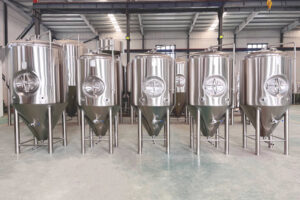
Craft Beer Brewing Equipment: The Complete Cellar-to-Glass Guide
Nancy Shang | Founder & CEO, MICET | Published August 26, 2026 Craft beer brewing equipment covers six linked stages: grain milling, the brewhouse, fermentation, bright tank conditioning, cleaning and glycol utilities, and packaging. For breweries between 3.5 and 30 BBL, sizing decisions at each stage set your annual capacity ceiling long before your recipes

Craft Beer System: The Cellar Setup Behind Great Small-Batch Beer
Nancy Shang | Founder & CEO, MICET | Published August 22, 2026 A craft beer system is a brewhouse plus the cellar that feeds it: fermenters, brite tanks, glycol, CIP and water treatment. The brewhouse sets batch size once. The cellar decides how many batches per month you actually finish, and whether batch nine tastes

Stout Brewing Tanks: Fermenter Considerations for Dense, Nitrogenated Beers
Nancy Shang | Founder & CEO, MICET | Published August 20, 2026 Stout brewing tanks are conical fermenters and brite tanks configured for dense, high-gravity dark beers: extra headspace for aggressive krausen, a cone that handles heavy trub, and a pressure-rated brite tank plumbed for nitrogen blending. The tank shape is standard. The configuration around

Industrial Brewing Equipment: From 15 BBL to Regional-Scale Lines
Nancy Shang | Founder & CEO, MICET | Published August 14, 2026 Industrial brewing equipment covers systems roughly 15 BBL and up, where heating method, automation level, and grain handling move from craft workarounds to purpose-built infrastructure. This guide covers what changes between a 15 BBL brewhouse and an 80 BBL four-vessel line, including budget

Best Commercial Brewing Equipment: How to Actually Evaluate a System
Nancy Shang | Founder & CEO, MICET | Published August 13, 2026 Commercial brewing equipment quality shows up in details vendor pages skip: weld penetration, jacket coverage, and control panel logic. This guide breaks down eight factors that separate a system built for years of production from one built to look good on a spec
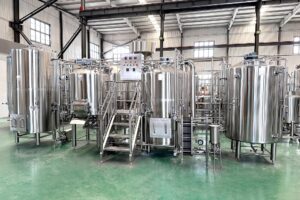
Brewery Bottling Equipment: Line Types, Speeds & DO Control
Brewery bottling equipment splits into three functional classes: gravity fillers, counter-pressure fillers, and rotary isobaric lines. That choice sets your dissolved oxygen pickup, achievable speed, and capital exposure. Most craft producers stay with counter-pressure well past their first expansion; rotary isobaric earns its cost only when sustained bottle volume justifies both the machine and the

Brewery Pumps: Sanitary Centrifugal, PD & When to Use Each
A brewery pump is a sanitary-construction pump that moves wort, beer, water, or cleaning chemicals without contaminating them. Two families cover almost every craft brewery: centrifugal pumps for water, wort, and CIP flow, and positive displacement pumps for thick, delicate, or high-viscosity transfers. Selection turns on flow, head, temperature, and seal type. What makes a
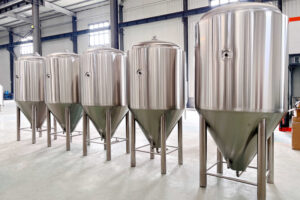
Equipment Needed to Start a Brewery: A Founder’s Ordered Checklist
Nancy Shang | Founder & CEO, MICET | Updated July 2026 Most brewery equipment lists read like a shopping cart. They aren’t wrong about what you need — they’re wrong about when you need it. Order a brewhouse before your floor drains are roughed in, and you’ll be paying contractors to rip up concrete twice.
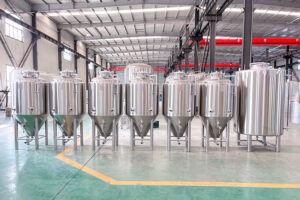
Stainless Steel Beer Brewing Equipment: 304 vs 316L, Welds & Longevity
Nancy Shang | Founder & CEO, MICET | Updated July 2026 A tank’s grade stamp tells you less than its weld record does. Two systems both marked “304 stainless” can last five years or twenty-five depending on shell thickness, weld method, and whether the water touching the metal has been treated first. What “Stainless Steel

Hot Liquor Tank in Brewing: HLT Sizing, Heating & Common Mistakes
Nancy Shang | Founder & CEO, MICET | Published July 2026 A hot liquor tank (HLT) heats and holds brewing water for mashing, sparging, and cleaning. For most commercial systems, size it at roughly twice your brewhouse batch volume, insulate it if you heat overnight, and match the heat source — electric, steam, or gas